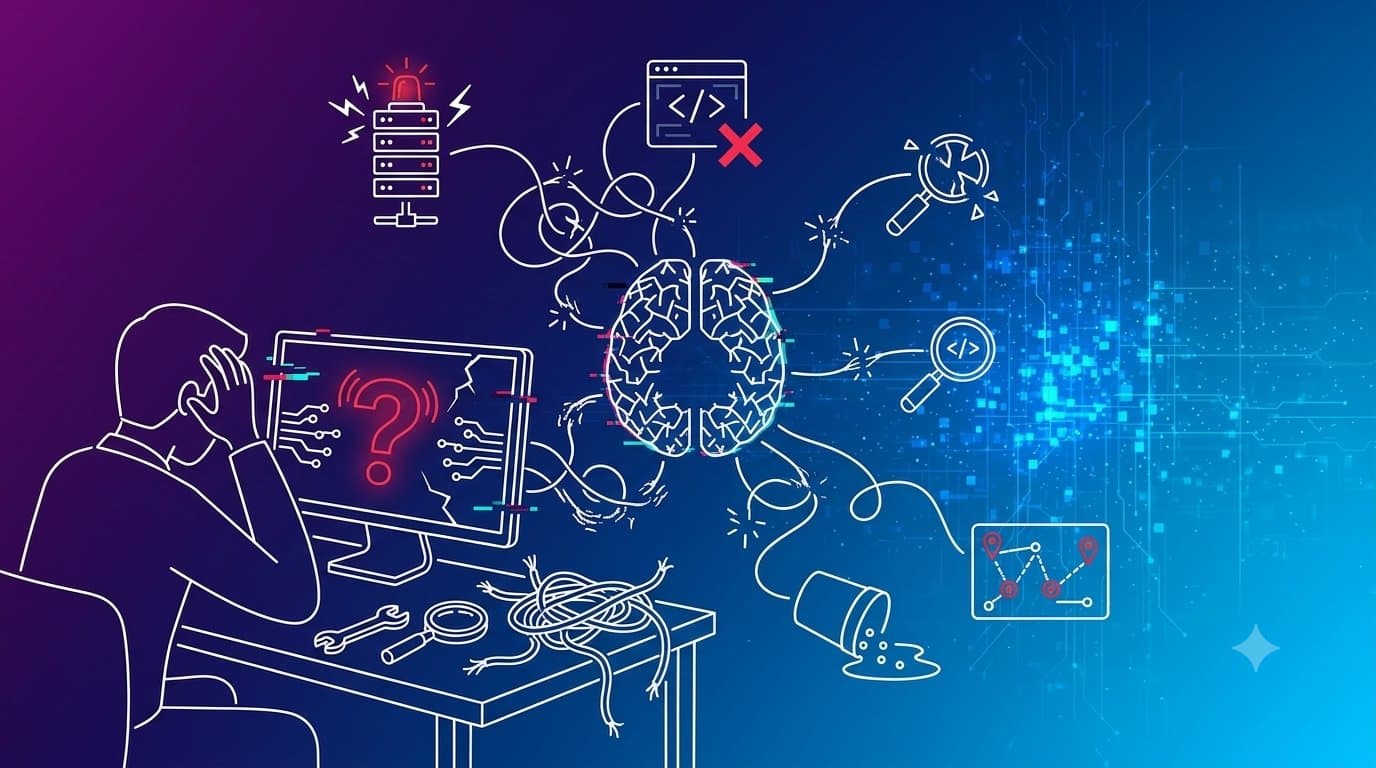
Traditional IT troubleshooting methods are costing organizations thousands of hours and millions of dollars annually in lost productivity and extended downtime. While IT teams continue to rely on manual processes, ticket queues, and legacy monitoring tools, infrastructure issues pile up faster than administrators can resolve them. The gap between incident detection and resolution has become a critical bottleneck that threatens business continuity and team morale.
TL;DR Quick Answer
Traditional IT troubleshooting methods create five critical challenges: extended mean time to resolution due to ticket queue bottlenecks, knowledge retention gaps when senior administrators are unavailable, alert fatigue from false positives, inability to scale manual processes with infrastructure growth, and hidden costs from downtime and reactive firefighting.
Key Takeaways
- Ticket queue bottlenecks increase mean time to resolution by 300 to 500 percent compared to instant automated responses, creating cascading delays across IT operations
- Knowledge retention problems leave junior administrators unable to resolve complex issues when senior team members are unavailable, extending incident resolution times by hours or days
- Alert fatigue from traditional monitoring tools generates 40 to 60 percent false positives, causing teams to miss critical incidents buried in noise
- Manual troubleshooting processes cannot scale with infrastructure growth, forcing IT teams into constant reactive firefighting instead of strategic initiatives
- The hidden costs of traditional troubleshooting include downtime expenses averaging $5,600 per minute, productivity losses, and opportunity costs from delayed projects
What Are Traditional IT Troubleshooting Methods?
Traditional troubleshooting relies on manual ticket systems, reactive monitoring, and human-driven diagnostics to address infrastructure, networking, and security issues. These methods emerged decades ago when IT environments were simpler and more predictable. Today, despite massive increases in infrastructure complexity, most organizations still depend on these legacy approaches.
The typical traditional troubleshooting process follows a predictable pattern. An alert triggers in a monitoring system, generating a ticket in an ITSM platform. That ticket enters a queue where it waits for assignment based on priority and available staff. Once assigned, an administrator manually investigates the issue, consults documentation or colleagues, implements a fix, and verifies the resolution. This entire workflow requires significant human intervention at every step.
Common tools in traditional troubleshooting include legacy ITSM platforms like ServiceNow or Remedy, basic monitoring dashboards that track system metrics, runbook documentation stored in wikis or shared drives, and communication tools for escalation and collaboration. These tools support manual processes rather than automating them.
The fundamental characteristic of traditional troubleshooting is its reactive nature. IT support teams respond to problems after they occur and after users or monitoring systems detect them. This reactive stance keeps administrators in constant firefighting mode, addressing symptoms rather than preventing issues or identifying root causes proactively.
Tribal knowledge plays an outsized role in traditional troubleshooting. Senior system administrators accumulate years of experience navigating infrastructure quirks, understanding undocumented dependencies, and recognizing patterns that monitoring tools miss. This expertise becomes essential for resolving complex issues but creates organizational vulnerabilities when those individuals are unavailable.
Key Components of Traditional Troubleshooting
Traditional troubleshooting workflows consist of several interconnected components that define how IT teams operate. The ticketing system serves as the central hub, tracking all incidents from creation through resolution. Monitoring tools provide visibility into infrastructure health but typically lack intelligence to distinguish genuine issues from noise.
Documentation repositories store runbooks, configuration guides, and historical incident records. However, these documents quickly become outdated as infrastructure evolves. Communication channels enable escalation between support tiers and coordination among team members during complex incidents.
The human element remains the most critical component. Administrators bring judgment, pattern recognition, and problem-solving skills that traditional tools cannot replicate. This dependency on human expertise creates both the strength and weakness of traditional troubleshooting methods.
Challenge 1: Ticket Queue Bottlenecks and Extended Mean Time to Resolution
Summary: Ticket queue bottlenecks represent the single largest contributor to extended mean time to resolution, with incidents waiting hours or days for assignment while infrastructure issues compound and business operations suffer.
Ticket-based troubleshooting systems create inherent delays that dominate overall resolution time. Research shows that average ticket queue wait times range from two to 24 hours before an administrator even begins investigating an issue. During this waiting period, the underlying problem often worsens, affecting more users and systems.
Queue prioritization mechanisms, while intended to ensure critical issues receive attention first, frequently create unintended consequences. Non-critical tickets can block urgent infrastructure issues when priority levels are assigned incorrectly or when high-priority tickets overwhelm available capacity. Administrators spend valuable time triaging and reprioritizing rather than solving problems.
Handoffs between support tiers add multiple delay points to the resolution process. A tier one technician receives the initial ticket, performs basic diagnostics, then escalates to tier two when the issue exceeds their expertise. Tier two may escalate further to tier three specialists or vendor support. Each handoff requires context transfer, queue time at the new tier, and potential rework if information was lost in translation.
After-hours incidents present particularly severe challenges in traditional troubleshooting workflows. Issues detected outside business hours typically wait until the next day for resolution unless they trigger on-call escalation. Even with on-call coverage, response times stretch significantly compared to business hours when full teams are available.
The impact on mean time to resolution metrics is dramatic. Organizations using traditional troubleshooting methods report MTTR measurements that include far more queue time than actual troubleshooting and resolution time. An incident that requires 15 minutes of hands-on work might show an MTTR of four hours or more when queue delays are included.
Automated IT troubleshooting eliminates these bottlenecks entirely. Platforms like Sudoji resolve incidents instantly without human assignment or prioritization delays, reducing MTTR by orders of magnitude compared to ticket-based workflows.
How Ticket Queues Create Cascading Delays
The cascading effect of ticket queues extends beyond individual incidents. When queues grow long, administrators rush through resolutions to clear backlogs, increasing the likelihood of incomplete fixes that generate repeat tickets. Users experiencing issues submit multiple tickets when initial responses are slow, further clogging the queue with duplicates.
Resource constraints worsen as queues lengthen. Administrators face pressure to work faster rather than more thoroughly, leading to band-aid solutions instead of root cause fixes. Management responds by hiring additional staff, but new team members require months of training before becoming productive, during which time they may actually slow down experienced administrators who must mentor them.
The psychological impact on IT teams compounds operational problems. Constant backlog pressure creates stress and burnout, reducing job satisfaction and increasing turnover. This turnover then feeds back into the knowledge retention problems discussed in the next challenge.
Challenge 2: Knowledge Retention and Tribal Knowledge Gaps
Summary: Knowledge retention problems create critical vulnerabilities when complex infrastructure issues require specific expertise that only senior administrators possess, leaving junior team members unable to resolve incidents during off-hours or when key personnel are unavailable.
Senior administrators accumulate deep knowledge about infrastructure quirks, undocumented workarounds, and complex issue patterns over years of hands-on experience. This tribal knowledge becomes essential for troubleshooting but exists primarily in individual minds rather than in accessible, actionable formats. When a senior team member takes vacation, calls in sick, or leaves the organization, that expertise becomes temporarily or permanently unavailable.
Documentation efforts struggle to capture the nuanced decision-making that experienced troubleshooters apply. Written runbooks describe procedures but cannot anticipate every variation or edge case. The context that makes a senior administrator effective includes understanding why certain solutions work, recognizing subtle symptoms that indicate specific root causes, and knowing which documented procedures are outdated or unreliable.
Staff turnover results in permanent knowledge loss that impacts future incident resolution capability. According to industry research, IT organizations lose critical institutional knowledge when experienced staff depart, and rebuilding that expertise through new hires takes 12 to 18 months minimum. During this rebuilding period, incident resolution times increase and the risk of misdiagnosis rises.
Junior administrators escalate issues they could potentially resolve if proper knowledge transfer had occurred. This escalation pattern creates bottlenecks at senior levels and prevents junior staff from developing expertise. The learning curve for complex infrastructure environments stretches across years, during which junior team members remain dependent on senior guidance.
Training programs attempt to address knowledge gaps but face inherent limitations. Classroom training and documentation cannot replicate the pattern recognition that comes from resolving hundreds of real incidents. Mentorship programs help but require significant time investment from senior staff who are already overloaded with troubleshooting responsibilities.
AI-powered platforms like Sudoji address knowledge retention by capturing and applying learning insights from every resolved incident. This institutional knowledge persists regardless of staff changes, ensuring consistent troubleshooting capability across the entire infrastructure.
The Cost of Unavailable Expertise
The financial and operational costs of unavailable expertise manifest most clearly during critical incidents that occur outside business hours or when key personnel are absent. A complex networking issue that a senior administrator could resolve in 30 minutes might take a junior team member four hours of trial and error, escalation attempts, and vendor support calls.
Organizations often maintain expensive on-call rotations specifically to ensure senior expertise remains available around the clock. These rotations create work-life balance challenges and contribute to burnout. Despite this investment, response times during off-hours still exceed business hours performance because on-call staff must context-switch from personal time and may lack immediate access to tools and documentation.
The opportunity cost of concentrated expertise extends beyond incident resolution. When only senior administrators can handle complex issues, those individuals spend their time firefighting instead of working on strategic initiatives, infrastructure improvements, or automation projects that would reduce future incident volume.
Challenge 3: Alert Fatigue and False Positive Management
Summary: Alert fatigue from traditional monitoring tools generates overwhelming volumes of notifications with false positive rates between 40 and 60 percent, causing administrators to miss genuine critical incidents buried in noise while wasting hours investigating non-issues.
Traditional monitoring tools lack the context and intelligence to distinguish genuine problems from temporary anomalies or expected behavior. These tools generate alerts based on threshold violations without understanding whether those violations indicate actual issues requiring intervention. The result is a flood of notifications that overwhelm IT teams and obscure truly critical incidents.
Research indicates that false positive rates in traditional monitoring environments range from 40 to 60 percent. This means that nearly half of all alerts that administrators investigate turn out to be non-issues. The time spent on false positive investigation represents pure waste, consuming capacity that could address real problems or proactive improvements.
High false positive rates train administrators to ignore or delay investigating alerts. This learned behavior creates dangerous situations where genuine critical incidents get dismissed as likely false positives. Teams develop informal rules about which alerts to trust and which to ignore, but these heuristics fail when new types of issues emerge or when infrastructure changes invalidate previous assumptions.
Alert tuning becomes a never-ending task that consumes administrator time without fundamentally solving the underlying problem. Teams adjust thresholds, add filters, and create exception rules to reduce noise. However, infrastructure changes constantly, and tuning efforts struggle to keep pace. Overly aggressive tuning risks missing genuine issues, while conservative tuning perpetuates the noise problem.
The cognitive load of constant alerts degrades decision-making quality and contributes to burnout. Administrators experience notification fatigue similar to the phenomenon documented in healthcare settings, where excessive alarms lead to delayed responses and missed critical events. The psychological impact extends beyond work hours as on-call staff receive alerts during evenings and weekends.
AI infrastructure monitoring addresses alert fatigue by applying machine learning to distinguish genuine incidents from noise. Platforms like Sudoji automatically resolve issues before they require human attention, eliminating the notification entirely rather than simply filtering it.
Why Traditional Monitoring Creates More Noise Than Signal
The technical limitations of traditional monitoring tools explain their poor signal-to-noise ratios. These tools monitor individual metrics in isolation without understanding relationships between components or normal behavior patterns. A CPU spike might indicate a problem or simply reflect expected batch processing. Traditional tools cannot tell the difference.
Threshold-based alerting assumes that exceeding a specific value always indicates a problem. This assumption breaks down in dynamic environments where normal behavior varies by time of day, day of week, or business cycle. Static thresholds generate false positives during expected high-utilization periods and miss issues during low-utilization periods when absolute values remain below thresholds despite representing anomalies.
The proliferation of monitoring tools compounds the noise problem. Organizations typically deploy separate tools for infrastructure monitoring, application performance monitoring, network monitoring, security monitoring, and log aggregation. Each tool generates its own alerts without coordination, creating duplicate notifications for the same underlying issue and making correlation nearly impossible.
Challenge 4: Inability to Scale Manual Processes with Infrastructure Growth
Summary: Manual troubleshooting processes cannot scale proportionally with infrastructure growth, forcing IT teams into constant reactive firefighting as the ratio of infrastructure components to administrators increases beyond sustainable levels.
Infrastructure complexity grows exponentially while IT team size grows linearly or remains flat due to budget constraints. This divergence creates an unsustainable situation where each administrator must manage increasingly large and complex environments. What worked when an organization operated 100 servers fails completely at 1,000 servers or 10,000 containers.
Cloud adoption, microservices architectures, and distributed systems multiply troubleshooting complexity beyond what manual processes can handle. Modern infrastructure spans multiple cloud providers, on-premises data centers, edge locations, and SaaS services. Issues frequently cross domain boundaries, requiring expertise in networking, security, infrastructure, and application layers simultaneously.
The following table illustrates how infrastructure growth outpaces IT team scaling:
| Infrastructure Size | Typical IT Team Size | Components per Admin | Troubleshooting Capacity |
|---|---|---|---|
| 100 servers | 5 administrators | 20:1 | Manageable manually |
| 500 servers | 8 administrators | 63:1 | Strained capacity |
| 2,000 servers | 12 administrators | 167:1 | Constant firefighting |
| 10,000 containers | 15 administrators | 667:1 | Unsustainable |
Cross-domain issues spanning networking, security, and infrastructure require multiple specialists to collaborate on resolution. Traditional troubleshooting workflows struggle with these scenarios because ticket systems are designed for linear workflows, not collaborative problem-solving across domains. Coordination overhead increases as more specialists become involved, and handoffs between domains add delays similar to tier escalations.
Hiring additional administrators provides diminishing returns as team size grows. Larger teams require more coordination, more meetings, more documentation, and more process overhead. Communication complexity grows exponentially with team size, following Metcalfe's Law. At a certain point, adding team members actually slows down troubleshooting rather than accelerating it.
Automated IT troubleshooting scales infinitely without adding headcount or coordination overhead. An autonomous IT support agent like Sudoji installs across entire infrastructure to provide consistent troubleshooting capability that grows automatically with infrastructure expansion.
The Cross-Infrastructure Troubleshooting Complexity Problem
Modern infrastructure issues rarely respect traditional domain boundaries. A performance problem might originate in network congestion, manifest as application slowness, trigger security alerts due to retry storms, and impact database performance through connection pool exhaustion. Diagnosing and resolving this scenario requires expertise across networking, application architecture, security operations, and database administration.
Traditional troubleshooting workflows assign tickets to specific teams based on initial symptoms. When the assigned team discovers the issue spans multiple domains, they must coordinate with other teams, often through additional tickets or informal communication channels. This coordination takes time and frequently results in finger-pointing as each team investigates their domain in isolation.
The velocity of infrastructure change compounds complexity. Continuous deployment practices mean that infrastructure configuration changes constantly. An issue that appears today might relate to a change deployed yesterday, last week, or last month. Correlating incidents with changes requires tracking deployment history across multiple systems and teams, a task that overwhelms manual processes.
Challenge 5: Hidden Costs of Reactive Troubleshooting and Extended Downtime
Summary: The hidden costs of traditional troubleshooting extend far beyond IT labor expenses to include downtime costs averaging $5,600 per minute, productivity losses across affected teams, opportunity costs from delayed strategic projects, and competitive disadvantages from slower incident response.
Downtime costs vary significantly by industry and organization size but represent substantial financial impact. According to Gartner research, the average cost of IT downtime is $5,600 per minute for enterprise organizations. For e-commerce companies, financial services firms, and other digitally dependent businesses, costs can exceed $9,000 per minute. These figures include direct revenue loss, productivity impact, and recovery costs.
Productivity losses extend beyond the IT team to affect all employees dependent on affected systems. When email systems fail, entire organizations lose communication capability. When ERP systems experience issues, business operations grind to a halt. The cumulative productivity loss across hundreds or thousands of employees quickly dwarfs the direct cost of the technical issue itself.
Reactive firefighting prevents IT teams from executing strategic initiatives and infrastructure improvements. Administrators spend 60 to 80 percent of their time responding to incidents rather than working on projects that would improve reliability, performance, or security. This reactive stance creates a vicious cycle where lack of proactive work leads to more incidents, which consume more time, leaving even less capacity for improvements.
Opportunity costs include delayed product launches, missed revenue opportunities, and competitive disadvantages. When IT teams are perpetually firefighting, business initiatives that depend on IT support get postponed. In fast-moving markets, these delays can mean losing first-mover advantage or missing market windows entirely.
Customer satisfaction and brand reputation suffer from prolonged outages and service degradation. Users experiencing frequent issues lose confidence in the platform and may switch to competitors. The reputational damage from high-profile outages can persist long after technical issues are resolved, affecting customer acquisition and retention.
Network troubleshooting automation and other forms of automated IT troubleshooting reduce total cost by eliminating ticket queue delays, preventing recurring issues through learning insights, and freeing IT teams for strategic work that improves overall reliability.
Calculating the Total Cost of Traditional Troubleshooting
Organizations can assess their own troubleshooting costs by calculating several key metrics. Start with direct downtime costs by multiplying average incident duration by downtime cost per minute, then multiplying by incident frequency. Add IT labor costs by calculating hours spent on troubleshooting multiplied by fully loaded hourly rates for administrators at each tier.
Include opportunity costs by estimating the value of strategic projects delayed or cancelled due to lack of IT capacity. This calculation requires business input but often represents the largest cost component. Factor in the cost of customer churn attributable to service reliability issues, using customer lifetime value metrics.
The total cost of traditional troubleshooting typically exceeds visible IT labor costs by a factor of five to ten when all hidden costs are included. This calculation provides the business case for investing in automated IT troubleshooting platforms that address these costs systematically.
How Automated IT Troubleshooting Addresses These Challenges
Summary: Automated IT troubleshooting platforms address traditional challenges by eliminating ticket queues through instant incident resolution, capturing institutional knowledge in AI models, filtering noise with intelligent monitoring, scaling automatically with infrastructure growth, and shifting teams from reactive firefighting to proactive optimization.
AI-powered agents like Sudoji.io resolve incidents instantly without human assignment or queue delays. When an issue is detected, the AI system administrator immediately begins diagnosis and implements fixes without waiting for ticket creation, prioritization, or human availability. This instant response reduces mean time to resolution from hours to seconds for common issues.
Machine learning captures and applies troubleshooting knowledge across all incidents. Every resolution becomes a learning opportunity that improves future performance. The system builds institutional knowledge that persists regardless of staff turnover and remains available 24/7 without on-call rotations or escalation delays.
Intelligent monitoring distinguishes genuine issues from false positives and resolves them autonomously. Rather than generating alerts for human investigation, an AI IT operations platform diagnoses root causes and implements fixes automatically. Administrators receive notifications only for issues requiring human judgment or for informational awareness.
The following table compares traditional and automated approaches:
| Aspect | Traditional Troubleshooting | Automated IT Troubleshooting |
|---|---|---|
| Initial Response Time | 2-24 hours (queue wait) | Instant (no queue) |
| Knowledge Dependency | Senior admin expertise | AI-captured institutional knowledge |
| False Positive Handling | Manual investigation | Automatic filtering and resolution |
| Scalability | Linear with headcount | Infinite without additional staff |
| Team Focus | Reactive firefighting | Proactive optimization |
Automation scales infinitely without adding headcount or coordination overhead. An autonomous infrastructure agent monitors and manages thousands of servers, containers, and network devices simultaneously. As infrastructure grows, the AI system administrator extends coverage automatically without requiring additional training, onboarding, or team expansion.
Proactive issue prevention reduces total incident volume and associated costs. Intelligent incident resolution systems identify patterns that precede failures and implement preventive measures before issues impact users. This shift from reactive to proactive operations fundamentally changes the economics of IT operations.
Platforms like Sudoji combine instant resolution, learning insights, and cross-domain troubleshooting to address all five traditional challenges simultaneously. By installing across entire infrastructure, Sudoji provides comprehensive coverage for infrastructure, networking, and security issues without the limitations of manual processes.
Frequently Asked Questions
What are the biggest challenges IT teams face with traditional troubleshooting?
IT teams face five interconnected challenges with traditional troubleshooting methods. Ticket queue bottlenecks extend mean time to resolution by forcing incidents to wait hours or days before administrators begin work, during which time problems worsen and business impact grows. Knowledge retention gaps create vulnerabilities when complex issues require expertise that only senior administrators possess, leaving junior team members unable to resolve incidents when key personnel are unavailable. Alert fatigue from false positives overwhelms teams with noise, causing them to miss critical incidents buried in thousands of low-priority notifications. Inability to scale manual processes with infrastructure growth forces teams into constant reactive firefighting as the ratio of components to administrators becomes unsustainable. Hidden costs from downtime and reactive work include direct financial losses averaging $5,600 per minute, productivity losses across affected teams, and opportunity costs from delayed strategic initiatives. These challenges compound each other and worsen as infrastructure complexity increases, creating a vicious cycle that traditional approaches cannot break.
How can automation help IT service desks reduce ticket volume?
Automation reduces ticket volume by resolving common incidents instantly before they require human intervention, eliminating the need for users to submit tickets or for monitoring systems to generate them. An AI system administrator like Sudoji.io handles routine issues like service restarts, resource utilization problems, network connectivity troubleshooting, and configuration drift automatically. These incident types typically represent 60 to 80 percent of total ticket volume in traditional environments. Automation also prevents recurring issues through learning insights that identify root causes and implement permanent fixes rather than temporary workarounds. By analyzing patterns across incidents, automated systems detect systemic problems that generate multiple tickets and address them proactively. False positive filtering eliminates another significant source of unnecessary tickets by distinguishing genuine issues from monitoring noise. Organizations implementing comprehensive automated IT troubleshooting typically see ticket volume reductions of 40 to 70 percent, freeing IT service desk capacity for issues that genuinely require human judgment and creativity.
Why do IT support teams struggle with long resolution times?
IT support teams struggle with long resolution times due to multiple factors that compound throughout the troubleshooting workflow. Ticket queue wait times often exceed actual troubleshooting time, with incidents sitting unassigned for hours or days before work begins. Handoffs between support tiers add delays at each escalation point as tickets move from tier one to tier two to tier three or specialist teams. Knowledge gaps require escalation to senior staff who may be unavailable, busy with other incidents, or outside business hours. Time spent investigating false positives diverts capacity from genuine issues and trains administrators to delay alert investigation. The complexity of cross-domain troubleshooting requires coordination between networking, security, infrastructure, and application teams, each with their own queues and priorities. Traditional tools provide limited visibility into relationships between components, forcing administrators to manually correlate events and test hypotheses through trial and error. Documentation is often outdated or incomplete, requiring administrators to rediscover solutions or consult colleagues. These factors combine to create resolution times measured in hours or days for issues that automated systems resolve in seconds or minutes.
What repetitive tasks consume most of an IT help desk's time?
Password resets and access management consume 20 to 30 percent of help desk time in typical organizations, despite being highly routine and automatable. Investigating false positive alerts from monitoring systems wastes another 15 to 25 percent of capacity on non-issues that require no action. Restarting services and servers to clear transient issues represents 10 to 15 percent of tickets, a task that automated systems handle instantly. Network connectivity troubleshooting for common issues like DHCP problems, DNS resolution failures, and routing misconfigurations accounts for 10 to 15 percent of workload. Routine configuration changes such as adding users to groups, adjusting permissions, or updating settings consume 8 to 12 percent of time. Documenting known issues and updating runbooks takes 5 to 10 percent of capacity but often gets deferred due to incident pressure. Collectively, these repetitive tasks consume 60 to 80 percent of help desk capacity in traditional environments. All of these tasks are candidates for automation through AI-powered platforms that handle routine work autonomously while escalating only genuinely novel issues to human administrators.
How can AI improve network troubleshooting and diagnostics?
AI improves network troubleshooting through pattern recognition that identifies root causes faster than manual analysis by correlating events across multiple network devices, logs, and metrics simultaneously. Machine learning models trained on historical incidents recognize signatures of specific problems and apply proven solutions instantly. Automated diagnostics test multiple hypotheses in parallel rather than sequentially, dramatically accelerating the investigation phase. AI systems learn from past incidents to resolve similar issues instantly without repeating diagnostic steps, building institutional knowledge that improves over time. Cross-correlation of network events with infrastructure and security data reveals relationships that human administrators might miss, especially in complex distributed environments. Predictive capabilities identify degradation patterns before they cause outages, enabling proactive intervention. The speed advantage is substantial because AI can analyze thousands of data points per second while human administrators work through diagnostic steps manually. Network troubleshooting automation handles complexity beyond human capacity, managing large-scale environments with thousands of network devices and millions of flows simultaneously while maintaining consistent diagnostic quality regardless of time of day or administrator availability.
What are common IT support problems that can be automated?
Service restarts and health checks represent the most commonly automated IT support problems, with AI systems detecting degraded services and restarting them automatically while verifying successful recovery. Network connectivity and routing issues including DHCP failures, DNS resolution problems, and routing table misconfigurations are resolved autonomously through automated diagnostics and remediation. Disk space and resource utilization problems trigger automatic cleanup of temporary files, log rotation, and capacity alerts before users experience impact. AI security incident response handles known threat patterns by isolating affected systems, blocking malicious traffic, and implementing containment measures instantly. Configuration drift detection and remediation ensures systems maintain desired state by automatically correcting unauthorized or accidental changes. Performance degradation diagnostics identify resource bottlenecks, inefficient queries, and capacity constraints, implementing optimizations or scaling resources as needed. These common problems share characteristics that make them ideal automation candidates: they occur frequently, follow recognizable patterns, have well-defined resolution procedures, and require speed more than creativity. Automated sysadmin tools handle these issues in seconds versus the minutes or hours required for manual troubleshooting, dramatically reducing mean time to resolution and freeing human administrators for complex problems requiring judgment.
Traditional troubleshooting methods impose significant costs on IT organizations through extended resolution times, knowledge gaps, alert fatigue, scalability limitations, and hidden downtime expenses. As infrastructure complexity continues to grow, these challenges will only intensify for teams relying on manual processes and legacy tools. Organizations seeking to reduce mean time to resolution, eliminate ticket queue bottlenecks, and free IT teams for strategic work should evaluate how AI-powered automation can transform their troubleshooting capabilities. The shift from reactive firefighting to proactive optimization begins with understanding these five fundamental challenges and exploring solutions that address them systematically.