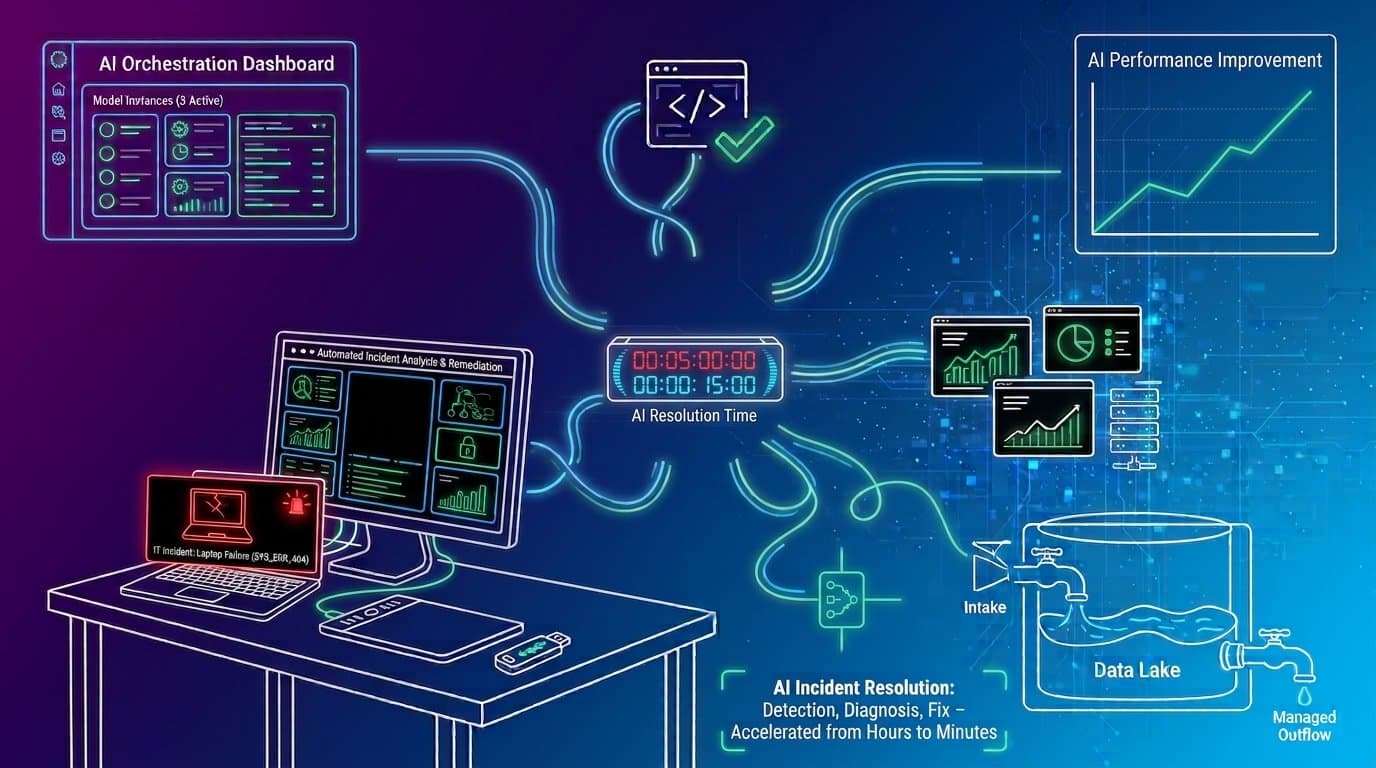
IT teams spend countless hours triaging tickets, diagnosing infrastructure failures, and manually resolving incidents that follow predictable patterns. AI incident management transforms this reactive cycle into autonomous resolution, eliminating ticket queues and reducing mean time to resolution from hours to seconds. Modern AI-powered systems can now troubleshoot, diagnose, and fix IT infrastructure issues across networking, security, and system administration without human intervention.
TL;DR Quick Answer
AI incident management uses autonomous agents to automatically detect, diagnose, and resolve IT infrastructure issues without creating tickets, reducing mean time to resolution by up to 95% while eliminating repetitive manual troubleshooting.
Key Takeaways
- Autonomous AI agents resolve incidents instantly without ticket creation, while AI-assisted tools still require human intervention and traditional ITSM workflows
- AI-powered incident management reduces MTTR from hours to minutes by performing root cause analysis and executing fixes across infrastructure, networking, and security domains simultaneously
- Modern AI systems learn from incident patterns to improve resolution accuracy over time, building institutional knowledge that survives team turnover
- Infrastructure-wide AI deployment eliminates up to 80% of routine incidents before they impact end users or require escalation
- Organizations implementing autonomous incident resolution report 60-75% reduction in ticket volume and 40-50% improvement in SLA compliance within 90 days
What is AI Incident Management?
AI incident management is the automated detection, diagnosis, and resolution of IT infrastructure issues using machine learning and autonomous agents. This approach fundamentally differs from traditional monitoring and alerting systems that simply notify human responders when problems occur.
The technology operates across three distinct levels. AI-assisted tools augment human responders by providing suggested actions, enriched alerts, and guided troubleshooting steps. These systems still require manual intervention and follow traditional ITSM workflows with ticket creation and queue assignment. Autonomous AI agents, by contrast, complete the entire resolution lifecycle independently. They detect anomalies, perform root cause analysis, execute remediation actions, and verify fixes without creating tickets or waiting for human approval.
Core capabilities include pattern recognition that identifies incident signatures across vast amounts of telemetry data, root cause analysis that traces problems to their underlying source rather than just symptoms, automated remediation that executes proven fixes instantly, and cross-domain troubleshooting that addresses complex issues spanning infrastructure, networking, and security simultaneously.
The evolution from traditional monitoring represents a fundamental shift in operational philosophy. Legacy systems focused on alerting humans as quickly as possible. Modern AI incident management eliminates the human bottleneck entirely for routine incidents, reserving human expertise for truly novel or high-risk scenarios. According to Quinnox, AI-driven incident operations can deliver up to 60% faster resolution and 30–50% fewer customer-visible outages.
By 2026, leading incident management platforms are using autonomous AI to automate up to 80% of incident response tasks, according to incident.io. This represents a massive acceleration from experimental pilots to production-grade autonomous operations.
Key Terms in AI Incident Management
Mean Time to Resolution (MTTR): The average time from incident detection to complete resolution and service restoration. AI systems dramatically compress this metric by eliminating queue delays and manual diagnosis steps.
Root Cause Analysis (RCA): The process of identifying the underlying source of an incident rather than just addressing symptoms. AI performs RCA by correlating data across multiple systems and comparing current incidents against historical patterns.
Autonomous Remediation: The execution of fixes and corrective actions by AI agents without requiring human approval or manual intervention. This capability distinguishes true autonomous agents from AI-assisted tools.
Alert Correlation: The process of grouping related alerts from multiple monitoring sources into a single incident context. AI excels at correlation by understanding system topology and dependency relationships that humans might miss.
How Does AI Improve Incident Management?
AI improves incident management by automating the entire resolution lifecycle from detection through remediation, using pattern recognition to diagnose issues in seconds and executing fixes without creating tickets or waiting for human assignment.
Instant detection and correlation represent the first major improvement. Traditional monitoring generates separate alerts for each affected component, creating alert storms that overwhelm on-call engineers. AI systems correlate these signals in real time, understanding that 50 alerts about database connectivity, application timeouts, and load balancer errors all stem from a single network configuration change. This correlation happens in milliseconds rather than the minutes or hours required for human analysis.
Automated root cause analysis leverages historical incident data and deep understanding of system topology. When a service degrades, AI doesn't just identify which component failed. It traces the failure back through dependency chains, examining recent changes, resource utilization patterns, and similar past incidents to pinpoint the underlying cause. A recent study reported 63% of organizations already using AI-assisted incident response, with another 34% planning to adopt it, according to InvGate.
Autonomous execution of remediation actions eliminates the longest delays in traditional incident response. After diagnosing a problem, AI agents execute proven fixes immediately. Restarting a crashed service, rolling back a problematic configuration change, scaling resources to handle unexpected load, or adjusting firewall rules to restore connectivity all happen without ticket creation or queue assignment. The fix begins executing within seconds of detection.
Continuous learning from resolution outcomes improves accuracy and expands coverage over time. Every incident an AI system resolves becomes training data. The system learns which diagnostic steps proved most valuable, which remediation actions worked, and which incident signatures correlate with specific root causes. This knowledge accumulation happens automatically, building institutional expertise that persists regardless of team turnover.
Proactive incident prevention through pattern recognition represents the ultimate evolution. As AI systems accumulate resolution history, they begin identifying precursor signals that predict incidents before they occur. Resource exhaustion trends, configuration drift patterns, and performance degradation signatures all become opportunities for preventive action rather than reactive firefighting.
SudoJi demonstrates these capabilities by deploying across entire infrastructure to resolve incidents instantly without ticket creation, learning from each resolution to expand its autonomous capabilities. The system operates as an AI system administrator that handles infrastructure, networking, and security incidents with the same expertise a senior engineer would apply, but at machine speed and scale.
AI-Powered Root Cause Analysis
Root cause analysis traditionally requires experienced engineers to manually correlate logs, metrics, and traces across multiple systems. This process can take hours for complex incidents spanning multiple infrastructure layers.
AI performs this analysis in seconds by processing vastly more data points than any human could examine. The system simultaneously analyzes application logs, infrastructure metrics, network flow data, security events, and change management records. It identifies temporal correlations, understands normal baseline behavior for each component, and recognizes deviation patterns that indicate specific failure modes.
The accuracy advantage comes from pattern matching against thousands of previous incidents. Where a human engineer might remember a handful of similar problems they've personally resolved, AI systems compare the current incident against every resolution in their training data. This comprehensive pattern library enables faster and more accurate diagnosis, especially for intermittent or complex multi-system failures.
Autonomous Resolution Without Human Intervention
The distinction between AI-assisted tools and autonomous AI agents centers on who executes the fix. AI-assisted platforms suggest remediation steps, provide runbook guidance, or pre-populate ticket fields with diagnostic information. A human still reviews the recommendation, approves the action, and manually executes the fix or delegates it through traditional workflows.
Autonomous AI agents execute remediation directly. When the system diagnoses a failed service that requires restart, it performs the restart immediately. When root cause analysis identifies a misconfigured load balancer rule, the agent corrects the configuration without creating a change request ticket. When security analysis detects a compromised credential, the system revokes access and forces re-authentication automatically.
Safety mechanisms prevent autonomous agents from making high-risk changes without oversight. Confidence thresholds ensure the system only acts autonomously when diagnosis certainty exceeds defined levels. Rollback capabilities allow instant reversion if a remediation action doesn't produce the expected outcome. Circuit breakers halt autonomous operations if error rates spike or if the system encounters scenarios outside its training data.
Autonomous AI Agents vs. Traditional Monitoring Tools
Traditional monitoring tools detect and alert on incidents but require human responders to diagnose and fix issues, while autonomous AI agents complete the entire resolution cycle independently, eliminating ticket queues and manual troubleshooting steps.
| Capability | Traditional ITSM | AI-Assisted Tools | Autonomous AI Agents |
|---|---|---|---|
| Detection | Threshold-based alerts | Enhanced pattern detection | Multi-signal correlation |
| Diagnosis | Manual log analysis | Suggested root causes | Automated RCA with topology awareness |
| Ticket Creation | Required for all incidents | Required for all incidents | No tickets for autonomous resolutions |
| Queue Assignment | Manual routing to teams | Smart routing suggestions | No queue delays |
| Remediation | Human-executed fixes | Guided human execution | Autonomous execution with safety controls |
| Typical MTTR | 2-8 hours | 1-4 hours | 2-15 minutes |
| Learning | Static runbooks | Limited feedback loops | Continuous improvement from outcomes |
| Cross-Domain | Separate tools per domain | Partial integration | Unified infrastructure, network, security |
Traditional ITSM workflows begin with alert generation from monitoring tools. These alerts create tickets that enter assignment queues. An on-call engineer receives the ticket, begins manual diagnosis by examining logs and metrics, formulates a hypothesis about root cause, tests potential fixes, and executes remediation. Post-incident reviews document the resolution for future reference. This entire cycle typically requires two to eight hours for routine incidents.
AI-assisted tools enhance this workflow by providing smarter alerting, suggested diagnostic steps, and recommended actions. They might pre-populate tickets with relevant context, route incidents to the most appropriate team based on historical patterns, or surface similar past incidents for reference. However, human responders still perform the actual diagnosis and execute the fixes. MTTR improves to one to four hours, but the fundamental bottleneck of human availability and manual execution remains.
Autonomous AI agents eliminate the ticket entirely for incidents within their resolution capability. Detection triggers immediate diagnosis. Root cause analysis completes in seconds. Remediation executes automatically. Verification confirms the fix worked. The entire cycle completes in two to 15 minutes without human intervention. The system only escalates to human responders when it encounters scenarios outside its confidence thresholds or when incidents require judgment calls about business impact tradeoffs.
Everbridge research team notes that AI currently functions mainly as a copilot in incident management, but the market is moving toward governed autonomous orchestration and eventual autonomous resolution. This transition reflects growing confidence in AI safety mechanisms and expanding training data that improves autonomous decision-making accuracy.
Each approach has appropriate use cases. Traditional ITSM remains necessary for novel incidents, high-risk changes, and scenarios requiring business context that AI systems don't possess. AI-assisted tools work well for organizations beginning their automation journey or for incident types where human judgment adds significant value. Autonomous AI agents deliver maximum value for high-volume, repetitive incidents that follow predictable patterns and have well-defined remediation procedures.
SudoJi operates as an autonomous AI system administrator agent, not just an AI-assisted monitoring tool, providing instant resolution across infrastructure, networking, and security without creating tickets. This positioning reflects the fundamental architectural difference between augmentation and autonomy.
Benefits of Automated Incident Resolution for IT Teams
Automated incident resolution delivers measurable ROI through 60-80% ticket volume reduction, 70-95% MTTR improvement, enhanced SLA compliance, and freed capacity for strategic IT initiatives instead of repetitive troubleshooting.
Ticket volume reduction represents the most immediate visible impact. Organizations implementing autonomous AI agents report 60-75% fewer tickets reaching human responders within 90 days of deployment. These eliminated tickets represent routine incidents that AI resolves completely without human awareness. Database connection pool exhaustion, service crashes requiring restart, configuration drift corrections, resource scaling adjustments, and network path optimizations all happen automatically. The remaining tickets represent genuinely complex problems that benefit from human expertise.
MTTR improvement transforms service reliability metrics. Resolution times drop from hours to minutes for incidents within autonomous resolution scope. Where traditional workflows required ticket assignment, engineer availability, manual diagnosis, and human-executed fixes, autonomous agents complete the entire cycle in under five minutes for most routine incidents. This compression directly reduces customer-visible downtime and business impact.
SLA compliance improvements follow naturally from MTTR reduction. Service level agreements typically define acceptable response and resolution timeframes. When 70% of incidents resolve in minutes instead of hours, overall SLA compliance rates improve by 40-50%. Organizations that previously struggled to meet aggressive SLA targets find themselves consistently exceeding commitments.
Cost savings accumulate across multiple dimensions. Reduced on-call burden means fewer middle-of-the-night pages for routine issues that AI handles autonomously. Lower escalation rates decrease the need for expensive senior engineer time on repetitive problems. Decreased downtime impact translates directly to reduced revenue loss and customer satisfaction improvements. Organizations investing in AI initiatives report that 51% have deployed them and 86% expect to by 2027, according to Runframe, though the same research notes operational toil rose from 25% to 30%, highlighting the importance of proper implementation.
Team capacity liberation may deliver the greatest long-term value. When IT staff spend 60-80% less time on repetitive incident firefighting, that capacity redirects to innovation, infrastructure improvements, automation expansion, and strategic projects that drive business value. Engineers report higher job satisfaction when freed from mundane troubleshooting to focus on challenging technical problems.
Knowledge retention becomes AI-native rather than dependent on individual employees. Traditional incident response expertise lives in the heads of senior engineers. When those engineers leave, institutional knowledge disappears. AI systems capture resolution patterns, diagnostic techniques, and remediation procedures in machine learning models that persist indefinitely. New team members benefit from accumulated expertise immediately rather than spending years building experience.
Organizations deploying SudoJi report 60-75% ticket reduction and resolution times dropping from hours to under two minutes for infrastructure and networking incidents. These metrics reflect real production deployments across diverse infrastructure environments, not theoretical projections.
How AI Reduces MTTR in IT Operations
AI reduces mean time to resolution by eliminating ticket queue wait times, performing parallel diagnostics across multiple systems simultaneously, and executing proven remediation actions instantly without requiring human approval or manual execution.
Elimination of ticket queue delays removes the longest component of traditional MTTR. In conventional workflows, incidents wait in queues until an engineer becomes available. Queue times vary from minutes during business hours to hours overnight or during major outages when all responders are occupied. AI agents begin resolution immediately upon detection, with no queue whatsoever. The clock starts and stops within the same minute for many routine incidents.
Parallel processing enables simultaneous analysis across infrastructure, networking, and security domains. A human engineer troubleshooting a service outage might first check application logs, then examine infrastructure metrics, then investigate network connectivity, then review security events. Each step happens sequentially. AI systems analyze all these data sources simultaneously, correlating signals across domains in real time. A problem that requires 20 minutes of sequential human investigation completes in 30 seconds of parallel AI analysis.
Instant remediation execution applies fixes the moment diagnosis completes. No approval workflows, no change advisory board meetings, no manual command execution. The AI agent identifies that a service needs restart, executes the restart command, monitors the service return to healthy state, and verifies that dependent services resume normal operation. Total elapsed time: 90 seconds. The same incident in a traditional workflow might require 45 minutes from detection to human-executed fix.
Pattern matching accelerates resolution for known issues. When AI encounters an incident signature it has seen before, it immediately applies the proven solution without repeating diagnostic steps. A configuration error that caused an outage last month gets corrected in seconds when it recurs, because the system recognizes the exact pattern and knows the fix that worked previously.
Concrete examples illustrate the time compression. Server restart automation detects an unresponsive application server, attempts graceful shutdown, forces termination if graceful shutdown times out, restarts the service, waits for health checks to pass, and returns the server to the load balancer pool. Traditional workflow: 30-60 minutes. AI autonomous resolution: two minutes.
Network configuration fixes identify misconfigured routing rules causing packet loss, compare current configuration against known-good baseline, generate corrected configuration, apply changes through infrastructure-as-code tooling, and verify traffic flow restoration. Traditional workflow: one to three hours. AI autonomous resolution: five minutes.
Security policy adjustments detect overly permissive firewall rules introduced by recent changes, identify the specific rules violating security baseline, generate compliant replacement rules, apply updated policies, and confirm no legitimate traffic disruption. Traditional workflow: two to four hours including security team consultation. AI autonomous resolution: eight minutes.
Resource allocation optimization identifies memory exhaustion causing application crashes, analyzes historical usage patterns to determine appropriate allocation, scales container resources or provisions additional capacity, and monitors for stability. Traditional workflow: 45 minutes to two hours. AI autonomous resolution: four minutes.
SudoJi resolves incidents across infrastructure, networking, and security simultaneously, addressing complex multi-domain issues that would require multiple specialized teams in traditional workflows. A single incident affecting database connectivity might involve infrastructure configuration, network routing, and security policy components. Traditional resolution requires coordination across three separate teams. Autonomous AI handles all three domains in a single unified resolution workflow.
Implementing AI Incident Management: A Practical Roadmap
Successful AI incident management implementation follows a phased approach starting with infrastructure assessment and pilot deployment, expanding through iterative learning cycles, and scaling to full autonomous resolution across all supported incident categories.
Infrastructure Assessment and Incident Pattern Analysis: Begin by analyzing your current incident volume, categorizing incidents by type, frequency, and resolution complexity. Identify high-volume, low-complexity incidents that follow predictable patterns. These represent ideal candidates for initial automation. Document current MTTR, ticket volume, and SLA compliance metrics to establish baseline measurements. Map your infrastructure topology, monitoring coverage, and existing automation capabilities. This assessment typically requires two to four weeks and produces a prioritized list of automation opportunities ranked by business impact and implementation feasibility.
Pilot Deployment on Low-Risk, High-Volume Incident Types: Select three to five incident categories for initial autonomous resolution. Choose scenarios with clear diagnostic criteria, well-defined remediation procedures, and low risk if automation fails. Common pilot candidates include service restarts, configuration drift corrections, and resource scaling adjustments. Deploy AI agents with monitoring and logging that captures every decision and action. Run in shadow mode initially, where AI performs diagnosis and recommends actions but doesn't execute autonomously. This phase validates diagnostic accuracy before enabling autonomous remediation. Pilot deployments typically run four to eight weeks.
Monitoring and Learning Period: Enable autonomous resolution for pilot incident categories while maintaining close observation. The AI system builds resolution confidence through repeated successful outcomes. Monitor false positive rates, remediation success rates, and any incidents requiring rollback or human intervention. Adjust confidence thresholds based on observed performance. Expand the incident signature library as the system encounters variations of known problems. This learning period typically lasts eight to 12 weeks, though systems continue learning indefinitely.
Gradual Expansion to Additional Incident Categories: Add new incident types to autonomous resolution scope in waves. Each expansion wave includes two to four additional categories, deployed with the same shadow mode validation and monitoring approach used in the pilot. Prioritize expansion based on business impact and observed AI performance confidence. More complex incident types with greater business risk require longer validation periods before enabling full autonomy. Most organizations achieve 60-70% incident coverage within six months and 80% coverage within 12 months.
Full Autonomous Operation with Continuous Learning: Transition to steady-state operations where AI handles the majority of routine incidents autonomously while continuously learning from outcomes. Establish governance processes for reviewing AI decisions, updating confidence thresholds, and expanding resolution capabilities. Implement feedback loops where human-resolved incidents train the AI system to handle similar problems autonomously in the future. Define escalation criteria for incidents outside autonomous resolution scope. Maintain human expertise for novel problems, high-risk changes, and scenarios requiring business context judgment.
Integration considerations significantly impact implementation success. Existing ITSM tools need API connectivity for the AI system to access incident history and resolution outcomes. Monitoring platforms must provide telemetry data the AI uses for diagnosis. Security controls should allow AI agents to execute remediation actions within defined guardrails. Change management processes require updates to accommodate autonomous changes while maintaining audit trails and compliance evidence.
Quinnox editorial team recommends that organizations should begin with low-risk automations such as alert enrichment and log collection, then expand to safe remediation only after defining confidence thresholds, rollback paths, and circuit breakers. This measured approach builds organizational confidence while minimizing risk.
SudoJi installs across entire infrastructure with minimal configuration, learning incident patterns during initial deployment and expanding autonomous resolution capabilities progressively. The system adapts to your specific infrastructure characteristics, application behaviors, and operational patterns without requiring extensive manual rule creation.
How AI Systems Learn and Improve Incident Resolution Over Time
Pattern recognition enables AI to identify recurring incident signatures and correlate them with successful resolutions. Each incident generates a unique fingerprint composed of symptoms, affected components, timing characteristics, and environmental context. When the system encounters a new incident, it compares this fingerprint against its entire resolution history. Matches above a similarity threshold trigger application of previously successful remediation procedures. Near-matches prompt diagnostic steps that proved valuable for similar incidents.
Outcome feedback loops train the model to improve future accuracy. Every resolution attempt produces an outcome: complete success, partial success requiring additional steps, or failure requiring human intervention. The AI system records which diagnostic hypotheses proved correct, which remediation actions worked, how long resolution took, and whether any rollback was necessary. This outcome data becomes training input that adjusts the model's confidence scores, diagnostic decision trees, and remediation selection logic.
Expanding resolution coverage happens progressively as confidence builds. Initially, the AI system might autonomously resolve only five to 10 incident types with extremely high confidence. As it accumulates successful resolutions and learns from human-resolved incidents, coverage expands to 20, then 50, then 100+ incident categories. The expansion follows a natural progression from simple, low-risk scenarios to more complex, multi-step resolutions. Incident.io editorial team notes that the incident management market is shifting from reactive alerting to proactive, AI-driven reliability platforms that embed automation directly into chat-native workflows.
Knowledge persistence ensures institutional knowledge captured in AI models survives team changes and turnover. When a senior engineer who has resolved hundreds of database incidents leaves the organization, their expertise typically leaves with them. AI systems retain every resolution pattern that engineer contributed, along with patterns from every other team member and every incident the system resolved autonomously. New engineers joining the team immediately benefit from this accumulated knowledge rather than spending years building personal experience.
Adaptation to infrastructure changes allows AI to learn new system behaviors and adjust resolution strategies. When you deploy new application versions, migrate to different infrastructure platforms, or adopt new technologies, the AI system observes how these changes affect incident patterns. It learns the normal behavior baselines for new components, identifies how failures manifest differently in the new environment, and discovers which remediation approaches work best. This adaptation happens continuously without requiring manual retraining or rule updates.
SudoJi continuously learns from every incident it resolves, building a knowledge base that improves resolution accuracy and expands autonomous capabilities without manual rule updates. The system becomes more valuable over time as it accumulates resolution experience specific to your infrastructure and operational patterns.
Frequently Asked Questions
What is AI-powered incident management?
AI-powered incident management is the use of artificial intelligence and machine learning to automatically detect, diagnose, and resolve IT infrastructure incidents. The technology operates at two distinct levels. AI-assisted tools help human responders by providing suggested actions, enriched alerts, and guided troubleshooting steps, but still require manual intervention and follow traditional ITSM workflows with ticket creation. Autonomous AI agents resolve incidents independently by completing the entire lifecycle from detection through remediation without human involvement. Core technologies include pattern recognition that identifies incident signatures across telemetry data, automated root cause analysis that traces problems to underlying sources, and remediation execution that applies fixes instantly. Typical use cases span infrastructure domains including server and application failures, networking issues like routing misconfigurations and connectivity problems, and security incidents such as policy violations and credential compromises. The fundamental distinction from traditional monitoring is that AI systems don't just alert humans to problems but actively resolve them.
How does AI improve incident management?
AI improves incident management through several specific mechanisms that compress resolution time and reduce manual effort. Faster detection happens through continuous monitoring that identifies anomalies in real time rather than waiting for threshold breaches. Instant root cause analysis uses historical data and system topology understanding to pinpoint underlying problems in seconds instead of the minutes or hours required for manual investigation. Automated remediation executes fixes without human intervention, eliminating ticket queue delays and manual command execution. Continuous learning improves accuracy over time as the system trains on every resolution outcome. Organizations typically see MTTR reductions of 70-95% for routine incidents and ticket volume decreases of 60-80%. The improvements stem from eliminating ticket assignment delays that can add 30 minutes to several hours, enabling parallel processing across multiple systems that humans would analyze sequentially, and applying proven fixes instantly based on pattern matching against thousands of previous incidents. AI-based incident management is described as reducing alert noise, correlating events faster, and automating safe remediation workflows, according to Quinnox.
Can AI reduce MTTR in IT operations?
AI significantly reduces mean time to resolution, typically by 70-95% for routine incidents that fall within autonomous resolution scope. The mechanisms driving this improvement include elimination of ticket assignment delays where incidents no longer wait in queues for available engineers, instant diagnosis through pattern matching that recognizes known issues and applies proven solutions immediately, automated execution of fixes that happens in seconds rather than requiring manual command entry, and parallel analysis across multiple domains that compresses sequential troubleshooting steps. Concrete timeframe comparisons illustrate the impact. A service restart that requires 30-60 minutes in traditional workflows completes in two minutes with AI automation. Network configuration fixes that take one to three hours manually resolve in five minutes autonomously. Security policy adjustments requiring two to four hours including team coordination complete in eight minutes. The greatest MTTR improvements occur for high-frequency, low-complexity incidents that follow predictable patterns. Novel incidents, complex multi-system failures, and scenarios requiring business context judgment see smaller improvements because they still benefit from human expertise and decision-making.
How does AI help with root cause analysis?
AI performs root cause analysis by correlating data from multiple monitoring sources simultaneously, comparing current incidents against historical patterns, analyzing system dependencies and topology, and identifying underlying causes rather than just symptoms. The advantages over manual RCA include speed, with analysis completing in seconds instead of minutes or hours, accuracy from comparing against thousands of previous incidents rather than just the handful an individual engineer remembers, and comprehensiveness by processing vastly more data points than any human could examine. The AI system simultaneously analyzes application logs, infrastructure metrics, network flow data, security events, and change management records. It identifies temporal correlations that reveal cause-and-effect relationships, understands normal baseline behavior for each component, and recognizes deviation patterns that indicate specific failure modes. Learning from past RCA outcomes improves future analysis because the system records which diagnostic hypotheses proved correct and which investigation paths led to successful resolution. This accumulated knowledge enables faster and more accurate diagnosis, especially for intermittent or complex multi-system failures that challenge even experienced engineers.
What are the benefits of automated incident resolution?
Automated incident resolution delivers both quantitative metrics and qualitative improvements. MTTR reduction of 70-95% for routine incidents means faster service restoration and reduced customer impact. Ticket volume decrease of 60-80% frees IT teams from repetitive firefighting to focus on strategic work. Improved SLA compliance of 40-50% results from faster resolution and fewer breaches of service level commitments. Reduced on-call burden means fewer middle-of-the-night pages for routine issues that AI handles autonomously. Cost savings accumulate from decreased downtime impact, lower escalation rates, and reduced need for expensive senior engineer time on repetitive problems. Freed capacity for strategic work allows engineers to focus on infrastructure improvements, automation expansion, and innovation instead of constant incident response. Qualitative improvements include reduced stress and better work-life balance for IT staff who no longer face constant interruptions for routine problems. Knowledge retention benefits ensure resolution expertise persists in AI models even when experienced engineers leave the organization. New team members immediately benefit from accumulated institutional knowledge rather than spending years building personal experience through trial and error.
Can AI automate IT troubleshooting?
Modern AI can automate the majority of routine IT troubleshooting tasks across infrastructure, networking, and security domains. The best candidates for automation are high-frequency, low-complexity incidents that follow predictable patterns and have well-defined remediation procedures. Examples include service restarts, configuration drift corrections, resource scaling adjustments, network path optimizations, and security policy violations. Incidents that still require human expertise include novel problems the AI hasn't encountered before, complex multi-system failures with ambiguous root causes, high-risk changes that could impact business-critical services, and scenarios requiring judgment about business impact tradeoffs. The troubleshooting process AI follows mirrors human methodology but executes at machine speed. Symptom detection identifies deviations from normal behavior. Diagnostic testing gathers additional data to narrow the problem scope. Hypothesis generation proposes potential root causes based on symptom patterns. Solution validation confirms the fix resolved the underlying issue without creating new problems. Safety mechanisms prevent AI from making high-risk changes without oversight, including confidence thresholds that require human approval when diagnosis certainty falls below defined levels, rollback capabilities that instantly revert changes if remediation doesn't produce expected outcomes, and circuit breakers that halt autonomous operations if error rates spike or the system encounters unfamiliar scenarios.
AI incident management represents a fundamental shift from reactive firefighting to proactive, autonomous resolution that eliminates ticket queues and frees IT teams to focus on innovation rather than repetitive troubleshooting. Organizations implementing autonomous AI agents are seeing dramatic improvements in MTTR, ticket volume, and SLA compliance within their first 90 days of deployment. As AI systems continue learning from every incident they resolve, the gap between traditional manual approaches and AI-native incident management will only widen. Evaluate your current incident resolution workflows to identify high-volume, repetitive incidents that could be automated, and consider piloting an AI solution on a subset of your infrastructure to measure the impact firsthand.