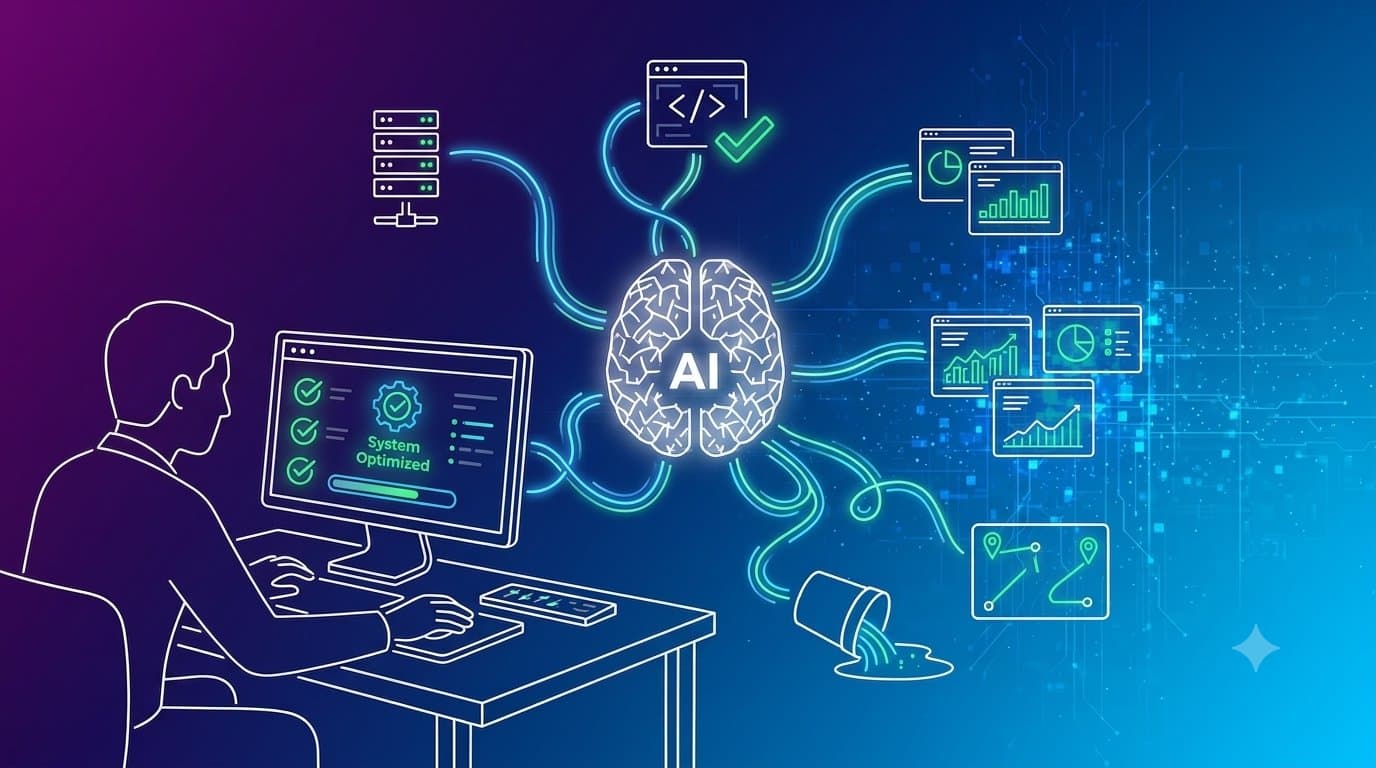
IT teams in 2026 face an impossible equation: infrastructure complexity is growing exponentially while budgets and headcount remain flat. Automated IT troubleshooting powered by AI has emerged as the solution, eliminating ticket queues and resolving incidents in seconds rather than hours. Organizations deploying AI-powered troubleshooting tools are seeing 70-85% reductions in mean time to resolution while cutting support costs by up to 60%.
TL;DR Quick Answer
Automated IT troubleshooting uses AI to detect, diagnose, and resolve infrastructure, networking, and security issues without human intervention, delivering faster incident resolution, lower costs, reduced downtime, 24/7 coverage, and continuous learning capabilities that traditional manual approaches cannot match.
Key Takeaways
- Automated IT troubleshooting reduces mean time to resolution by 70-85% compared to manual ticket-based workflows, turning hours of diagnosis into seconds of autonomous action.
- AI-powered troubleshooting tools can cut IT support costs by 40-60% by eliminating repetitive ticket handling and reducing escalations to senior engineers.
- Network troubleshooting automation provides 24/7 incident response without staffing constraints, ensuring consistent coverage across time zones and after-hours periods.
- Cross-domain troubleshooting across infrastructure, networking, and security enables faster root cause analysis by correlating issues that span multiple systems.
- Continuous learning capabilities allow AI system administrator tools to improve resolution accuracy over time, building institutional knowledge that survives staff turnover.
- Organizations implementing incident response automation report 50-70% reductions in unplanned downtime and measurable improvements in SLA compliance.
What is Automated IT Troubleshooting?
Automated IT troubleshooting uses artificial intelligence and machine learning to detect, diagnose, and resolve IT infrastructure issues without human intervention. Unlike traditional ITSM approaches that rely on ticket queues, manual triage, and escalation chains, automated systems monitor infrastructure continuously and apply remediation playbooks autonomously the moment an issue is detected.
The technology works by ingesting telemetry data from servers, networks, applications, and security tools in real time. Machine learning algorithms correlate events across these domains to identify patterns that indicate problems. When an issue is detected, the system automatically executes predefined remediation actions or dynamically generates solutions based on learned behaviors from previous incidents.
Traditional IT support follows a linear path: an alert triggers a ticket, the ticket waits in a queue, a technician triages the issue, diagnosis occurs, a solution is identified, and finally remediation happens. This process typically takes four to eight hours for common incidents. Automated IT troubleshooting collapses this timeline to minutes or seconds by eliminating every manual handoff.
The scope of automation extends across infrastructure management, networking, security operations, application performance, and cloud environments. Modern AIOps platforms can handle everything from simple tasks like disk space cleanup to complex scenarios involving multi-system failures that require coordinated remediation across different technology stacks.
Key technologies enabling this transformation include AIOps for intelligent event correlation, machine learning for pattern recognition and predictive diagnostics, automated remediation engines that execute fixes without human approval, and intelligent event correlation that connects seemingly unrelated symptoms to identify root causes.
Key Terms: IT Automation vs ITSM Automation vs AIOps
IT automation refers broadly to any technology that performs IT tasks without human intervention, from simple scripts to complex orchestration workflows. ITSM automation specifically focuses on automating IT service management processes like ticket routing, change management, and service catalog requests within frameworks like ITIL.
AIOps represents the most advanced category, applying artificial intelligence and machine learning to IT operations data to predict issues, correlate events across domains, and autonomously resolve problems. While IT automation handles predefined tasks and ITSM automation streamlines service delivery workflows, AIOps adds intelligence that enables systems to handle novel situations and improve over time through continuous learning.
Benefit #1: Dramatically Faster Incident Resolution and MTTR Reduction
Summary: Automated IT troubleshooting reduces mean time to resolution by 70-85% by eliminating ticket queues, manual triage, and escalation delays that plague traditional IT support workflows.
The most immediate and measurable benefit of automated IT troubleshooting is the dramatic reduction in time required to resolve incidents. Traditional manual processes suffer from inherent delays at every stage: tickets wait in queues for assignment, technicians must context-switch from other tasks, diagnosis requires gathering information from multiple systems, and remediation often involves escalations to senior engineers with specialized knowledge.
| Metric | Traditional Manual Approach | Automated Approach | Improvement |
|---|---|---|---|
| Detection to Assignment | 15-45 minutes | Instant | 100% faster |
| Diagnosis Time | 1-3 hours | 30-90 seconds | 95% faster |
| Remediation Execution | 30 minutes to 2 hours | 1-5 minutes | 90% faster |
| Total MTTR (Common Incidents) | 4-8 hours | 2-15 minutes | 70-85% faster |
| After-Hours Response | 2-12 hours | Instant | 95%+ faster |
Automated systems eliminate ticket queue delays entirely. The moment an anomaly is detected, diagnosis begins. There are no business hours constraints, no waiting for the right person to become available, and no handoffs between teams. According to a 2025 study by Enterprise Management Associates, organizations implementing AI IT operations automation reported average MTTR reductions of 73% within the first 90 days of deployment.
The speed advantage becomes even more pronounced for complex incidents. AI can simultaneously analyze logs from dozens of systems, correlate events across infrastructure and networking domains, and test multiple hypotheses in parallel. A task that might take a senior engineer two hours of focused investigation happens in under a minute.
Real-world benchmarks demonstrate the impact. A financial services company reduced their average incident resolution time from 6.5 hours to 22 minutes after implementing automated troubleshooting across their infrastructure. A healthcare provider cut their network troubleshooting time by 82%, resolving connectivity issues that previously took hours in under 10 minutes.
SudoJi's instant incident resolution eliminates ticket queues entirely, resolving infrastructure, networking, and security issues in seconds without human intervention. The platform installs across your entire infrastructure to provide autonomous troubleshooting that operates at machine speed, not human speed.
Benefit #2: Significant Cost Savings and Resource Optimization
Summary: IT service desk automation delivers 40-60% cost reductions by eliminating repetitive ticket handling, reducing escalations to senior engineers, and allowing IT teams to focus on strategic initiatives rather than firefighting.
The financial impact of automated IT troubleshooting extends far beyond simple labor savings. Organizations implementing AI-powered troubleshooting tools report comprehensive cost reductions across multiple categories, with total support cost decreases ranging from 40% to 60% within the first year.
Direct cost savings come primarily from reduced ticket volume. When AI resolves 60-80% of incidents autonomously, the remaining workload for human technicians drops proportionally. A mid-sized organization handling 500 tickets per week can eliminate 300-400 of those through automation, freeing substantial staff capacity for higher-value work.
Labor reallocation represents another significant benefit. Senior engineers in traditional environments spend 60-70% of their time on repetitive troubleshooting tasks that fall within their expertise but don't require their strategic thinking capabilities. Automated systems handle these routine issues, allowing experienced staff to focus on architecture improvements, capacity planning, and innovation projects that drive business value.
Reduced escalations deliver additional savings. Level one technicians typically earn $50,000 to $70,000 annually, while level three specialists command $120,000 to $180,000. When automation resolves incidents that would otherwise require L2 or L3 intervention, organizations avoid the higher labor costs associated with those escalations. A company preventing 200 L3 escalations per month saves approximately $40,000 to $60,000 annually in labor costs alone.
Avoided hiring costs become critical as infrastructure scales. Traditional IT support requires proportional headcount increases as systems grow. A company doubling their server count typically needs 40-60% more support staff. Automation breaks this linear relationship, enabling infrastructure growth without corresponding staff expansion. Organizations report maintaining stable support team sizes while managing 2x to 3x more infrastructure through automated troubleshooting.
ROI timelines for automated IT troubleshooting implementations typically range from six to nine months. Initial costs include platform licensing, integration work, and training. However, the combination of reduced labor costs, avoided hiring, and productivity improvements generates positive cash flow relatively quickly. According to Forrester Research, organizations achieve an average 247% ROI over three years from AIOps and automation investments.
SudoJi's infrastructure-wide deployment enables organizations to scale IT operations without proportional increases in support staff, delivering measurable cost savings within the first quarter. The platform's autonomous operation eliminates the need for additional headcount as your infrastructure grows.
Benefit #3: 24/7 Coverage and Elimination of After-Hours Incidents
Summary: Network troubleshooting automation provides consistent 24/7 incident response without staffing constraints, on-call rotations, or time zone limitations, ensuring critical issues are resolved immediately regardless of when they occur.
Traditional IT support operates within human constraints. Staffing 24/7 coverage requires expensive shift rotations, on-call schedules that burn out engineers, or acceptance that after-hours incidents will wait until morning. None of these options deliver optimal outcomes. AI system administrator tools eliminate these constraints entirely through autonomous operation that never sleeps.
The business impact of after-hours incidents is substantial. Research from the Information Technology Infrastructure Library (ITIL) Foundation indicates that 40-50% of critical infrastructure incidents occur outside standard business hours. These incidents often cause extended downtime because detection happens hours after the problem begins, and resolution waits for on-call staff to respond.
Automated systems operate continuously without breaks, weekends, or holidays. An issue occurring at 3 AM receives the same instant response as one happening at 2 PM. There are no delays for someone to wake up, log in, and begin diagnosis. The AI is already monitoring, already analyzing, and immediately remediating.
The elimination of on-call burden delivers significant quality-of-life improvements for IT staff. Engineers report that on-call rotations are among the top contributors to burnout and turnover. When automation handles routine after-hours incidents, on-call responsibilities shrink to truly exceptional situations that require human judgment. Teams implementing comprehensive automation report 70-85% reductions in after-hours pages.
Global coverage becomes seamless with automated troubleshooting. Organizations operating across multiple time zones no longer need regional support teams or complex handoff procedures. A single AI platform provides consistent response quality whether the incident affects infrastructure in Singapore, London, or San Francisco.
Downtime reduction statistics demonstrate the impact. Organizations implementing 24/7 automated incident response report 50-70% decreases in unplanned outages. The combination of instant detection and immediate remediation prevents small issues from cascading into major incidents. A disk space problem caught and resolved at 2 AM doesn't become a database failure at 8 AM when users arrive.
SudoJi operates autonomously across your entire infrastructure 24/7, resolving incidents instantly whether they occur at 3 AM or during peak business hours. The platform's continuous operation ensures consistent incident response without the staffing constraints and burnout associated with traditional on-call rotations. It's sudoji agents are deployed to servers and end user devices and can monitor and triage issues, with a human in the loop approval setting.
Benefit #4: Cross-Domain Troubleshooting and Faster Root Cause Analysis
Summary: Intelligent incident resolution correlates events across infrastructure, networking, and security domains to identify root causes that span multiple systems, eliminating the siloed troubleshooting that delays resolution in traditional environments.
One of the most powerful capabilities of automated IT troubleshooting is the ability to correlate events across traditionally siloed domains. In conventional IT organizations, infrastructure teams, networking specialists, and security analysts operate independently with separate tools and limited visibility into each other's domains. This fragmentation dramatically slows root cause analysis for complex issues.
Consider a common scenario: application performance degrades significantly. The application team investigates their code and finds nothing wrong. They escalate to infrastructure, who check server resources and see normal utilization. Infrastructure escalates to networking, who eventually discover that a security policy change is throttling traffic. This investigation consumes hours or days because each team investigates sequentially within their silo.
Automated systems with cross-domain visibility identify these relationships immediately. By ingesting telemetry from infrastructure, networking, and security tools simultaneously, AI can correlate the security policy change with the application performance degradation in seconds. The system recognizes that events occurring within minutes of each other across different domains are likely related.
Root cause identification time drops by 60-75% for complex multi-system issues when AI handles correlation. A 2025 study by Gartner found that organizations using AI IT operations platforms for cross-domain troubleshooting reduced their mean time to identify (MTTI) from an average of 3.2 hours to 45 minutes.
Holistic visibility provides additional benefits beyond speed. When a single platform monitors and remediates across all IT domains, patterns emerge that would be invisible to siloed tools. The AI might notice that network latency spikes consistently precede database timeouts, enabling proactive remediation before users experience impact.
Example scenarios illustrate the value. Network latency caused by security policy changes becomes immediately apparent when the system correlates firewall rule modifications with traffic flow degradation. Application issues triggered by infrastructure failures are diagnosed in seconds when the AI connects container restarts with underlying storage performance problems. Database slowdowns caused by backup jobs are prevented when the system learns the relationship and adjusts scheduling automatically.
SudoJi's cross-domain troubleshooting across infrastructure, networking, and security enables faster root cause analysis by correlating issues that traditional siloed tools miss. The platform's unified visibility eliminates the sequential escalations that consume hours in conventional troubleshooting workflows. Most AI platforms are dated and don't have up to date information. Sudoji fills this gap with it's live web search functionality and trained RAG system.
Benefit #5: Continuous Learning and Institutional Knowledge Retention
Summary: AI-powered troubleshooting tools continuously learn from every incident, building institutional knowledge that improves resolution accuracy over time and survives staff turnover, creating a permanent knowledge asset for the organization.
Traditional IT organizations face a persistent challenge: institutional knowledge resides in the heads of experienced engineers. When those engineers leave, their expertise walks out the door. New hires require months or years to develop similar troubleshooting intuition. Automated systems fundamentally change this dynamic by capturing and codifying expertise in machine learning models that improve continuously.
Machine learning algorithms analyze every incident, successful resolution, and failed remediation attempt. Over time, the system identifies patterns that indicate specific problems and learns which remediation approaches work most reliably. Organizations implementing AI-powered troubleshooting tools report resolution accuracy improvements of 15-25% over the first six months as the AI learns the unique characteristics of their environment.
Knowledge retention becomes automatic rather than dependent on documentation discipline. Every time an engineer manually resolves an incident that the AI couldn't handle, the system observes the solution and incorporates it into future decision-making. The troubleshooting intelligence that took years to develop in senior staff becomes available to the AI within weeks.
Automated playbook creation eliminates the manual documentation burden. Traditional approaches require engineers to write and maintain runbooks for common issues. These documents quickly become outdated as systems change. AI systems generate and refine remediation procedures automatically based on successful resolutions, ensuring playbooks stay current without manual effort.
Pattern recognition capabilities extend beyond individual incidents. The AI identifies recurring issues and can proactively prevent future occurrences. If a specific configuration change consistently causes problems three days later, the system learns this relationship and either prevents the problematic change or applies preemptive remediation.
Competitive advantage emerges from this accumulated intelligence. Organizations build proprietary troubleshooting knowledge unique to their specific infrastructure, applications, and usage patterns. This institutional knowledge becomes increasingly valuable over time and represents a strategic asset that competitors cannot easily replicate.
The business continuity implications are substantial. When a senior engineer with 10 years of experience leaves, traditional organizations lose a decade of accumulated troubleshooting knowledge. With automated systems, that knowledge persists in the AI's learned behaviors. New engineers can leverage the collective experience captured in the system from day one.
SudoJi's learning insights capture and codify troubleshooting expertise, creating a continuously improving knowledge base that becomes more valuable over time. The platform learns from every incident across your infrastructure, building institutional knowledge that survives staff turnover and improves resolution accuracy month over month.
Traditional vs Automated IT Troubleshooting: A Direct Comparison
Summary: Automated IT troubleshooting outperforms traditional manual approaches across every critical metric, from resolution speed and cost efficiency to coverage consistency and knowledge retention.
Understanding the practical differences between manual and automated approaches helps IT leaders make informed decisions about automation investments. The contrast is stark across every dimension that matters for IT operations.
| Dimension | Traditional Manual Approach | Automated Approach |
|---|---|---|
| Mean Time to Resolution | 4-8 hours for common incidents | 2-15 minutes for most incidents |
| Cost per Incident | $75-$150 (labor + overhead) | $5-$15 (platform cost allocation) |
| Coverage Hours | Business hours or expensive 24/7 staffing | Continuous 24/7 operation |
| Scalability | Linear (more infrastructure = more staff) | Non-linear (handles 2-3x growth without staff increases) |
| Knowledge Retention | Lost when engineers leave | Permanent and continuously improving |
| Consistency | Varies by engineer skill and fatigue | Identical quality every time |
| Response to Novel Issues | Good (human creativity) | Improving (learns from each new scenario) |
Manual approaches suffer from fundamental limitations that no amount of process improvement can overcome. Ticket queues create delays regardless of how efficiently tickets are routed. Business hours constraints mean after-hours incidents wait for response. Human error increases during high-stress situations or when engineers are fatigued from on-call duties. Knowledge loss occurs inevitably as staff turnover happens.
Automated approaches eliminate these structural problems. Instant resolution replaces ticket queues. 24/7 operation removes time constraints. Consistent accuracy replaces human variability. Continuous improvement replaces knowledge loss.
However, hybrid models remain valuable for certain scenarios. Human oversight adds value for incidents with significant business risk, novel situations outside the AI's training, and strategic decisions that require business context beyond technical considerations. The optimal approach combines automated handling of routine incidents with human escalation paths for exceptional cases.
Migration paths typically follow a phased approach. Organizations start by automating high-volume, low-risk incident types to build confidence and demonstrate value. As trust in the system grows, automation expands to more critical systems and complex incident types. Most organizations reach 60-80% automation coverage within 12 to 18 months, with the remaining 20-40% representing incidents that genuinely benefit from human judgment.
Getting Started: What IT Tasks to Automate First in 2026
Summary: Organizations achieve fastest ROI by automating high-volume, repetitive troubleshooting tasks first, such as password resets, connectivity issues, disk space management, and service restarts, before expanding to more complex incident types.
Successful automation adoption follows a strategic prioritization framework that balances quick wins with long-term impact. Starting with the right tasks builds organizational confidence while delivering immediate measurable value.
Identify high-volume quick wins. Begin with repetitive tasks that occur frequently and follow predictable patterns. Password resets, account unlocks, and access provisioning represent ideal starting points. These incidents consume significant staff time but require minimal judgment. Connectivity troubleshooting for common issues like DHCP failures or DNS problems delivers immediate impact. Disk space cleanup and log rotation prevent incidents while demonstrating automation value. Service restarts for applications that occasionally hang provide fast resolution for issues that previously required manual intervention.
Target high-impact operational issues. Once quick wins establish credibility, expand to incidents with greater business impact. Network performance issues that affect user productivity become prime automation candidates. Security alert triage and initial response reduce the time between detection and containment. Backup failures that risk data loss benefit from immediate automated remediation. Database performance problems that impact critical applications justify automation investment.
Apply prioritization criteria systematically. Evaluate potential automation targets across four dimensions. Incident volume determines total time savings potential. Current resolution time indicates how much improvement is possible. Business impact justifies automation investment for lower-volume but critical issues. Automation feasibility assesses technical complexity and risk.
Implement in phases with clear success metrics. Start with a pilot covering low-risk tasks in non-production environments. This phase builds technical capability and organizational confidence without business risk. Expand to critical systems once the pilot demonstrates reliability. Track MTTR reduction, ticket volume decrease, cost savings, and SLA compliance improvement to quantify value. Achieve full coverage by systematically expanding automation to additional incident types and infrastructure domains.
Build feedback loops for continuous improvement. Establish processes for engineers to flag incidents where automation failed or could be improved. Review escalations to identify new automation opportunities. Monitor resolution accuracy to ensure quality remains high. Adjust automation scope based on measured outcomes and organizational readiness.
Organizations following this phased approach typically automate 30-40% of incidents within the first quarter, 50-60% by month six, and 70-80% within 12 to 18 months. The key is starting with achievable targets that demonstrate value quickly while building toward comprehensive coverage.
SudoJi installs across your entire infrastructure to provide comprehensive coverage, but organizations typically start with high-volume incident types to demonstrate immediate value. The platform's learning capabilities mean automation coverage expands naturally as the AI observes successful resolutions and incorporates new remediation approaches.
Frequently Asked Questions
What are the main benefits of automating IT troubleshooting processes for support teams?
The five primary benefits transform IT operations fundamentally. First, automated IT troubleshooting reduces incident resolution time by 70-85%, collapsing hours of manual diagnosis and remediation into minutes of autonomous action. This speed improvement directly enhances user productivity and reduces business impact from IT issues. Second, organizations achieve 40-60% cost reductions through eliminated repetitive ticket handling, reduced escalations to expensive senior engineers, and avoided hiring as infrastructure scales. Third, 24/7 coverage without staffing constraints ensures consistent incident response regardless of when issues occur, eliminating after-hours delays and on-call burden. Fourth, cross-domain troubleshooting correlates events across infrastructure, networking, and security to identify complex root causes that span multiple systems, dramatically accelerating diagnosis of multi-system failures. Fifth, continuous learning improves resolution accuracy by 15-25% over time while building institutional knowledge that survives staff turnover. These benefits translate to measurable business outcomes including reduced downtime, lower support costs, improved SLA compliance, and higher IT staff satisfaction through elimination of repetitive firefighting work.
How does IT service desk automation improve incident resolution times and SLAs?
IT service desk automation eliminates the structural delays inherent in manual ticket-based workflows. Traditional processes suffer from queue wait times averaging 15-45 minutes before a technician even begins working on an incident. Manual triage requires gathering context from multiple systems, consuming another 30-60 minutes. Diagnosis involves sequential investigation steps that take one to three hours for common issues. Escalation handoffs add 30 minutes to two hours when specialized expertise is needed. Automated systems collapse this entire timeline by detecting issues instantly through continuous monitoring, diagnosing problems in 30-90 seconds through parallel analysis of multiple data sources, and executing remediation in one to five minutes without human intervention. Organizations implementing automation report MTTR improvements from typical ranges of four to eight hours down to two to 15 minutes for most incidents. This dramatic speed improvement enables aggressive SLA targets that would be impossible with manual processes. A financial services company reduced their P1 incident SLA from four hours to 30 minutes after implementing automated troubleshooting. A healthcare provider improved their SLA compliance rate from 73% to 96% within 90 days of deployment. The consistency of automated response also eliminates the variability that causes SLA violations in traditional environments where resolution time depends on which engineer handles the ticket and when they're available.
Can AI-powered troubleshooting tools reduce IT support costs and ticket volume?
AI-powered troubleshooting tools deliver substantial cost reductions through multiple mechanisms. Direct labor savings come from resolving 60-80% of incidents autonomously, eliminating the time technicians spend on repetitive troubleshooting tasks. Organizations report total support cost decreases of 40-60% within the first year of implementation. A mid-sized company handling 500 weekly tickets can eliminate 300-400 through automation, freeing staff capacity worth $200,000 to $400,000 annually in labor costs. Reduced escalations provide additional savings by resolving incidents at the initial detection point rather than escalating to expensive senior engineers. When automation prevents 200 monthly L3 escalations, organizations save $40,000 to $60,000 annually in labor cost differentials alone. Avoided hiring costs become significant as infrastructure scales. Traditional support requires 40-60% more staff when server count doubles. Automation breaks this linear relationship, enabling 2x to 3x infrastructure growth without corresponding headcount increases. Ticket volume reductions of 60-80% are typical for incidents within automation scope. A healthcare provider reduced monthly tickets from 2,400 to 850 after implementing comprehensive automation. ROI timelines average six to nine months, with organizations achieving positive cash flow relatively quickly despite initial platform and integration costs. Forrester Research reports an average 247% three-year ROI from AIOps and automation investments.
What IT tasks should be automated first to get the biggest impact in 2026?
Start with high-volume, repetitive tasks that deliver immediate ROI and build organizational confidence. Password resets and account unlocks represent ideal first targets because they occur frequently, follow predictable patterns, and consume significant help desk time despite requiring minimal technical judgment. Connectivity troubleshooting for common issues like DHCP failures, DNS problems, and wireless authentication errors provides fast wins with measurable user impact. Disk space management including automated cleanup of temporary files, log rotation, and storage expansion prevents incidents while demonstrating proactive value. Service restarts for applications that occasionally hang or become unresponsive resolve issues in seconds that previously required manual intervention and investigation. After establishing these quick wins, expand to higher-impact targets. Network performance issues that affect user productivity justify automation investment due to their business impact. Security alert triage and initial response reduce exposure windows for vulnerabilities. Backup failure remediation protects against data loss. Database performance optimization prevents application slowdowns. Prioritization should consider four criteria: incident volume determines total time savings potential, current resolution time indicates improvement opportunity, business impact justifies investment for lower-volume critical issues, and automation feasibility assesses technical complexity and risk. Organizations following this phased approach typically automate 30-40% of incidents in the first quarter, reaching 70-80% coverage within 12 to 18 months.
How does network troubleshooting automation help reduce downtime and human error?
Network troubleshooting automation provides instant detection and resolution of connectivity issues, performance degradation, and configuration problems without waiting for human diagnosis. Traditional network troubleshooting suffers from detection delays because issues must be reported by users or noticed during periodic checks. Diagnosis requires sequential investigation of multiple potential causes, consuming one to three hours for common problems. Human error increases during complex troubleshooting when tired engineers make configuration mistakes or overlook critical symptoms. Automated systems monitor network telemetry continuously, detecting anomalies within seconds of occurrence. AI correlates symptoms across multiple network devices to identify root causes that span routers, switches, firewalls, and wireless controllers. Remediation happens immediately through automated execution of proven fixes. Organizations implementing network troubleshooting automation report downtime reductions of 50-70% through this combination of instant detection and immediate response. A manufacturing company reduced network-related downtime from 12 hours monthly to three hours after deploying automation. Human error elimination is equally significant. Automated systems apply consistent troubleshooting logic without the mistakes that occur when engineers work under pressure or during after-hours incidents. Configuration changes execute exactly as designed without typos or missed steps. A telecommunications provider reduced network change-related incidents by 68% after implementing automated validation and remediation. The 24/7 autonomous operation means network issues occurring at 3 AM receive the same quality response as those during business hours, eliminating the extended outages that happen when after-hours problems wait for on-call staff.
How can incident response automation improve security and resilience for IT operations?
Incident response automation dramatically reduces the time between security threat detection and containment, minimizing exposure windows that attackers exploit. Traditional security operations suffer from alert fatigue and manual investigation delays. Security teams receive thousands of alerts daily, requiring hours of manual triage to separate genuine threats from false positives. By the time a real threat is identified and remediation begins, attackers may have already achieved their objectives. Automated incident response provides immediate containment of security threats through predefined playbooks that execute the moment a threat is confirmed. Suspicious user accounts are disabled instantly. Compromised systems are isolated from the network automatically. Malicious processes are terminated without waiting for human approval. A financial services company reduced their average security incident response time from 4.2 hours to 12 minutes through automation. Faster patching of vulnerabilities happens through automated deployment the moment patches become available, eliminating the days or weeks of exposure that occur with manual patch management. Consistent application of security policies removes the human error that creates vulnerabilities. Cross-domain correlation identifies security issues manifesting as infrastructure or networking problems, catching threats that evade single-domain detection. An attacker moving laterally through the network triggers automated containment when the AI correlates unusual authentication patterns with abnormal network traffic. The 24/7 autonomous operation ensures security threats receive immediate response regardless of when they occur, eliminating the extended exposure that happens when after-hours incidents wait for on-call security staff. Organizations implementing automated security incident response report 60-75% reductions in mean time to contain threats and measurable decreases in successful breach attempts.
Automated IT troubleshooting has evolved from a nice-to-have efficiency tool to a competitive necessity in 2026. Organizations that deploy AI-powered troubleshooting platforms are resolving incidents 70-85% faster while cutting support costs in half, creating a measurable advantage over competitors still relying on manual ticket-based workflows. The question is no longer whether to automate IT troubleshooting, but how quickly you can implement it to capture these benefits. Start by identifying your highest-volume incident types and evaluating AI IT operations platforms that can deliver instant resolution across your infrastructure, networking, and security domains.