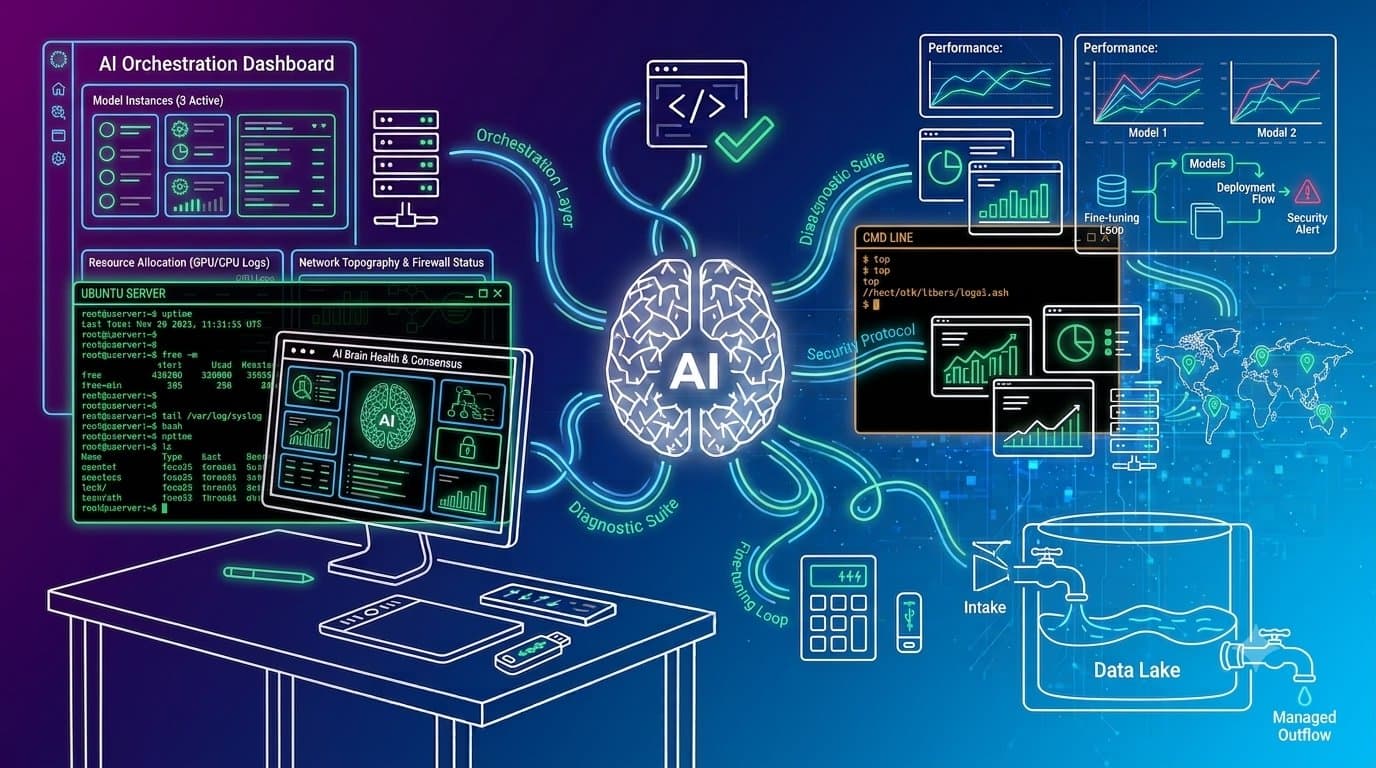
AI system administration is transforming how IT teams manage infrastructure, moving from reactive ticket queues to autonomous incident resolution. In 2026, AI agents can now monitor, troubleshoot, and fix infrastructure issues across networks, servers, and security systems without human intervention. This guide explains what AI system administration means for beginners, how it differs from traditional approaches, and practical steps to get started.
TL;DR Quick Answer
AI system administration uses autonomous agents and machine learning to automatically monitor, troubleshoot, and resolve IT infrastructure related issues, transforming traditional reactive sysadmin work into proactive, instant incident resolution.
Key Takeaways
- AI system administration combines autonomous agents with traditional sysadmin practices to eliminate ticket queues and enable instant incident resolution across infrastructure
- The technology works in two modes: AI-assisted tools that help human administrators and fully autonomous agents that resolve issues independently
- Beginners can user AI Agents like Sudoji to start with low-risk monitoring and alerting automation before progressing to autonomous troubleshooting and remediation
- Successful implementation requires infrastructure-wide deployment, integration with existing tools, and continuous learning capabilities
- AI will augment rather than replace system administrators, shifting their focus from routine fixes to strategic infrastructure planning and complex problem solving
- Measuring success involves tracking resolution time, ticket reduction, mean time to recovery, and learning improvement metrics
What is AI System Administration?
AI system administration applies machine learning and autonomous agents to infrastructure management tasks that traditionally required manual human intervention. Instead of waiting for alerts, creating tickets, and manually troubleshooting issues, AI-powered platforms continuously monitor systems, detect anomalies, diagnose root causes, and execute fixes automatically.
The technology operates in two distinct modes. AI-assisted tools function as copilots, providing recommendations and insights that human administrators review before taking action. Autonomous agents work independently, resolving known issues without requiring approval while logging every action for audit purposes.
Core capabilities include real-time infrastructure monitoring across servers, networks, applications, and security systems. Anomaly detection uses baseline learning to identify deviations from normal behavior patterns. Root cause analysis traces issues across distributed systems to pinpoint the actual source of problems rather than just symptoms. Automated remediation executes fixes for known issues, from restarting failed services to clearing disk space or renewing expiring certificates.
According to the PNW Research Series on AIOps and the future of systems administration, modern AIOps systems ingest metrics, logs, traces, and events from hundreds of sources and can process millions of data points per second. This processing power enables AI to correlate events across complex infrastructure that would overwhelm human operators.
The evolution from traditional reactive sysadmin work to proactive AI-driven operations represents a fundamental shift. Traditional system administrators spend most of their time responding to alerts, investigating issues, and manually executing fixes. AI system administration flips this model, handling routine troubleshooting automatically while freeing administrators to focus on strategic improvements, capacity planning, and complex architectural decisions.
Glossary of key terms:
- Autonomous agent: Software that monitors infrastructure and executes remediation actions independently based on learned patterns and predefined policies
- Incident resolution: The complete process of detecting, diagnosing, fixing, and verifying recovery from an infrastructure issue
- Infrastructure monitoring: Continuous observation of servers, networks, applications, and security systems to detect performance issues and failures
- Remediation: The automated execution of fixes to resolve detected infrastructure problems
- Sudoji: The AI Agent that helps IT Teams triage, troubleshoot and fix IT issues
Traditional System Administration vs. AI System Administration
Traditional system administration relies on reactive workflows. An issue occurs, monitoring tools generate an alert, a ticket enters the queue, an administrator investigates, identifies the root cause, and manually executes a fix. This process can take hours or days depending on ticket volume and team availability.
AI system administration operates proactively. Continuous monitoring detects anomalies before they cause outages. Pattern recognition identifies issues based on subtle deviations from baseline behavior. Root cause analysis happens in seconds rather than hours. For known issues, remediation executes automatically without creating tickets. The system learns from every incident, improving accuracy and expanding its remediation capabilities over time.
The time difference is substantial. Where traditional workflows might take 30 minutes to four hours to resolve a common issue like a failed service or full disk, autonomous agents can detect and fix the same problem in under one minute.
How AI is Changing the Role of System Administrators in 2026
The role of system administrators/infrastructure engineers is shifting from reactive firefighting to strategic infrastructure planning. AI handles routine troubleshooting tasks that previously consumed 60 to 70 percent of a typical sysadmin's day. This includes service restarts, log analysis, disk space management, certificate renewals, and basic network diagnostics.
According to Refonte Learning's analysis of system administration in 2026, administrators are expected to build competence in scripting, containers, cloud platforms, and ML operations fundamentals. The job is not disappearing but evolving into a hybrid role that combines traditional infrastructure knowledge with AI oversight capabilities.
New responsibilities include AI agent oversight, where administrators define policies for what the AI can fix automatically versus what requires human approval. Training data curation becomes important as teams review AI decisions to improve accuracy and reduce false positives. Automation strategy involves deciding which processes to automate first and how to measure success.
The collaboration model between human expertise and AI capabilities creates a force multiplier effect. AI provides speed and consistency for routine tasks. Humans provide context, judgment, and strategic thinking for complex scenarios. When an AI agent encounters an unfamiliar issue, it escalates to human administrators with detailed diagnostic data already collected, dramatically reducing investigation time.
Career growth opportunities in AI-augmented operations include specialization in AI operations engineering, infrastructure automation architecture, and AI governance for IT systems. Organizations need professionals who understand both traditional infrastructure and how to design, deploy, and optimize AI agents across their environment.
Core Capabilities of AI System Administration Platforms
Summary: AI system administration platforms deliver five core capabilities: continuous infrastructure monitoring, intelligent anomaly detection, automated root cause analysis, autonomous incident remediation, and learning-based improvement.
Infrastructure monitoring provides real-time visibility across servers, networks, applications, and security systems. Unlike traditional monitoring that relies on static thresholds, AI-powered monitoring establishes dynamic baselines for normal behavior. It tracks CPU utilization, memory consumption, disk I/O, network traffic, application response times, error rates, and security events simultaneously across thousands of endpoints.
Anomaly detection uses baseline learning and pattern recognition to identify issues before they cause outages. According to the PNW Research Series, AIOps platforms can reduce alert volume by 80 to 95 percent when used first for noise reduction and correlation before full remediation automation. This reduction happens because AI correlates related events, suppresses duplicate alerts, and filters out false positives that plague traditional monitoring systems.
Root cause analysis traces issues across distributed systems to identify the actual source of problems. When an application becomes slow, AI can determine whether the cause is database query performance, network latency, insufficient memory, or a recent configuration change. This analysis happens in seconds by examining logs, metrics, and traces across all related components.
Automated remediation executes fixes without human approval for known issues. The system maintains a library of proven solutions mapped to specific problem signatures. When it detects a match, it executes the fix, verifies recovery, and logs the action. For unfamiliar issues, it collects diagnostic data and escalates to human administrators with detailed context.
Continuous learning from every incident improves future responses. Each resolution, whether automated or human-driven, becomes training data. The system identifies patterns, refines its problem signatures, and expands its remediation library. Over time, the percentage of incidents resolved autonomously increases as the AI learns from experience.
SudoJi exemplifies these capabilities by deploying across entire infrastructure to provide instant resolution and learning insights. Rather than operating as a standalone monitoring tool, it installs at the infrastructure level to observe and act across servers and endpoints. It's natural language chat has a deep researched RAG which specifically monitors vendor support pages to get the most up to date knowledge on fixes and issues.
Autonomous Agents vs. AI-Assisted Tools
The distinction between autonomous agents and AI-assisted tools is critical for understanding what AI system administration can actually deliver. AI-assisted tools analyze data, generate recommendations, and present options to human administrators who make the final decision. They reduce investigation time but still require manual execution.
Autonomous agents make decisions and execute actions independently within defined policy boundaries. They monitor continuously, detect issues, diagnose root causes, execute fixes, and verify recovery without creating tickets or waiting for human approval. The key difference is authority to act.
Most organizations start with AI-assisted tools to build confidence, then gradually expand autonomous capabilities as they validate accuracy and establish governance policies. The goal is not to choose one approach permanently but to use both appropriately based on risk level and system criticality.
Getting Started: A Beginner Implementation Roadmap
Summary: Beginners should start with monitoring and alerting automation, progress to assisted troubleshooting, then advance to autonomous remediation for low-risk scenarios before expanding to critical systems.
Deploy AI monitoring and intelligent alerting. Start by connecting AI to your existing monitoring tools to reduce alert noise and improve correlation. This phase carries minimal risk because the AI observes and analyzes but does not execute changes. Focus on establishing baselines, identifying patterns, and validating that the AI correctly understands your infrastructure's normal behavior. According to IBM's 2026 guide to AI agents, this observability-first approach builds the foundation for later automation.
Enable AI-assisted troubleshooting with human approval. Configure the AI to provide diagnostic insights and recommend fixes for common issues. Administrators review recommendations and manually execute approved actions. This phase builds team confidence in AI accuracy while creating a library of validated solutions. Track how often AI recommendations prove correct and how much investigation time they save.
Automate remediation for well-defined, low-risk issues. Identify scenarios where the fix is reversible, the impact is limited, and the problem signature is clear. Examples include restarting failed services, clearing temporary files, renewing certificates before expiration, and adjusting resource limits. Configure the AI to handle these automatically while logging every action. According to guidance from the IT Infrastructure Management 2026 guide, effective AI operations teams should fix observability first, introduce AI in advisory mode, and only then automate reversible remediations.
Expand autonomous capabilities to broader infrastructure. As confidence builds and accuracy improves, gradually expand the types of issues the AI can resolve independently. Add more complex scenarios, increase the scope of affected systems, and refine policies for when to act autonomously versus when to escalate. Continuously measure resolution accuracy, false positive rates, and time savings.
Quick wins for beginners include log analysis to identify error patterns, disk space management to prevent storage-related outages, automated service restarts for known failure modes, and certificate renewal monitoring to avoid expiration-related incidents. These tasks are repetitive, time-consuming, and low-risk, making them ideal starting points.
Using SudoJi for Your First AI Administration Tasks
SudoJi's documentation at sudoji.io/docs/how-to-use demonstrates infrastructure-wide deployment that beginners can follow. The agent installs across your Linux and Mac infrastructure for now, with Windows coming soon.
After installation, SudoJi has built in tools to monitor, fix and configure immediately, establishing baselines for normal behavior across networks, servers, and applications. The learning phase typically runs for one to two weeks before enabling autonomous remediation (which is in beta), allowing the AI to understand your environment's unique patterns.
For your first autonomous task, configure SudoJi to handle service restarts for specific applications that occasionally fail but recover cleanly when restarted. Define the conditions that trigger action, such as three consecutive health check failures within five minutes. SudoJi will detect the failure, verify the diagnosis, restart the service, confirm recovery, and log the entire sequence without creating a ticket or requiring human intervention.
Essential Skills for AI System Administrators
Summary: AI system administrators need traditional sysadmin fundamentals plus new skills in AI oversight, automation strategy, data interpretation, and agent training.
Foundation skills in Linux and Windows administration, networking, and security basics remain essential. You cannot effectively oversee an AI that manages infrastructure you do not understand yourself. According to Refonte Learning's system administration skills analysis for 2026, future-ready sysadmins should combine Windows, Linux, shell scripting, permissions management, logging, automation, monitoring, and cloud basics with public proof of work and lab practice.
New skills include understanding ML models at a conceptual level. You do not need to build neural networks, but you should understand how AI learns from data, what training means, and why models can drift over time. Prompt engineering for AI agents involves crafting clear instructions and policies that guide autonomous behavior. Automation logic requires thinking through edge cases, failure modes, and rollback procedures.
Data literacy becomes critical for interpreting AI insights, validating recommendations, and identifying false positives. When the AI flags an anomaly, you need to assess whether it represents a genuine issue or a misunderstanding of normal behavior. This requires reading logs, analyzing metrics, and correlating events across systems.
Strategic thinking involves deciding what to automate, assessing risk, and establishing governance. Not every task should be automated immediately. You must evaluate the potential impact of automated actions, define approval requirements for high-risk changes, and establish monitoring to detect when AI behavior deviates from expectations.
Certifications and training resources for 2026 increasingly include AI operations modules. Traditional certifications like Red Hat Certified System Administrator and Microsoft Certified: Windows Server Hybrid Administrator Associate now include automation and AI integration topics. New certifications focused specifically on AIOps and AI infrastructure management are emerging from cloud providers and enterprise software vendors.
Comparing AI System Administration Tools and Platforms
Summary: AI system administration platforms range from AI-assisted monitoring tools to fully autonomous agents, with key differences in deployment scope, autonomy level, learning capabilities, and integration depth.
| Category | Autonomy Level | Infrastructure Coverage | Learning Capability | Integration Approach | Example Use Case |
|---|---|---|---|---|---|
| AI-assisted monitoring | Advisory only | Single domain (network, server, or application) | Pattern recognition | Adds AI layer to existing tools | Reducing alert noise in existing monitoring |
| Intelligent troubleshooting | Recommends actions | Multi-domain with manual correlation | Root cause analysis | Connects to multiple monitoring sources | Accelerating incident investigation |
| Autonomous agents | Independent execution | Infrastructure-wide deployment | Continuous learning from incidents | Installs across entire infrastructure | Eliminating ticket queues for routine issues |
Evaluation criteria for selecting a platform include autonomy level, which determines whether the AI assists or acts independently. Infrastructure coverage matters because issues often span networks, servers, and applications simultaneously. Learning capability affects how quickly the system improves and expands its remediation library. Integration depth determines how easily the platform fits into existing workflows.
Deployment models include cloud-based platforms that require no on-premise installation, on-premise solutions for organizations with strict data residency requirements, and hybrid approaches that combine local agents with cloud-based analytics.
Autonomous agents like SudoJi differ from traditional AI-assisted tools by eliminating the ticket queue entirely for routine issues. Rather than generating alerts that humans must investigate, autonomous agents detect, diagnose, fix, and verify recovery independently. This approach delivers instant incident resolution instead of faster ticket processing. It's entire chat dashboard is focused around helping and teaching IT teams to troubleshoot in the correct manner than just provide commands to run.
Security Considerations and Safe AI Adoption
Summary: Safe AI system administration requires access controls, approval workflows for high-risk actions, audit logging, rollback capabilities, and gradual expansion of autonomous permissions.
The principle of least privilege for AI agents means granting only the minimum permissions necessary for defined tasks. An AI handling service restarts does not need permission to modify network configurations or delete databases. According to Harvard Privacy & Security's best practices for managing generative AI systems, AI-enabled systems should be inventoried, ownership should be assigned, and new capabilities should be reviewed before deployment.
Approval gates for destructive or high-impact actions prevent autonomous execution of changes that could cause widespread outages. Deleting data, modifying production databases, changing network routing, and altering security policies should require human approval even when AI recommends the action. The AI can prepare the change and present it for review, but execution waits for explicit authorization.
Comprehensive audit trails and action logging record every decision the AI makes, every action it executes, and every escalation it triggers. These logs must be immutable and include sufficient detail to reconstruct the AI's reasoning. Audit requirements often mandate that automated actions be traceable to specific policies and training data.
Rollback and safety mechanisms allow rapid recovery when AI actions produce unexpected results. Before executing changes, the AI should capture the current state and create a restoration point. If the change does not achieve the intended outcome or causes new issues, automated rollback restores the previous configuration.
Security incident response with AI agents requires special consideration. AI can accelerate response by automatically isolating compromised systems, blocking malicious traffic, and collecting forensic data. However, attackers may attempt to manipulate AI behavior through prompt injection or by poisoning training data. According to Harvard Privacy & Security experts, external connectors should be treated as third-party integrations requiring security review, and unnecessary automated execution features should be disabled.
Frequently Asked Questions
What is AI system administration and how is it different from traditional sysadmin work?
AI system administration uses autonomous agents and machine learning to monitor, troubleshoot, and resolve infrastructure issues automatically, fundamentally changing how IT teams operate. Traditional sysadmin work is reactive: an issue occurs, monitoring generates an alert, a ticket enters the queue, an administrator investigates manually, identifies the root cause, and executes a fix.
This process can take hours or days depending on workload and team availability. AI system administration is proactive and autonomous: continuous monitoring detects anomalies before they cause outages, pattern recognition identifies issues based on subtle deviations, root cause analysis happens in seconds, and known issues are remediated automatically without creating tickets. The shift moves from ticket queues to instant resolution, from human-driven investigation to AI-driven diagnosis, and from manual fixes to automated remediation. AI handles routine troubleshooting tasks like service restarts, disk space management, and certificate renewals, while humans focus on strategic infrastructure planning, complex debugging that requires business context, and architectural decisions that shape long-term capabilities.
Can AI fully replace system administrators or will it mainly augment their work?
AI augments rather than replaces system administrators, transforming the role instead of eliminating it. Current AI excels at routine troubleshooting, continuous monitoring, pattern recognition, and resolving known issues with proven solutions. It struggles with tasks requiring business context, political judgment, creative problem-solving for novel issues, and strategic decisions about infrastructure architecture. According to the PNW Research Series on the future of systems administration, the operational model for agentic operations includes detect, diagnose, remediate, and verify as the core workflow, but human oversight remains essential for policy definition, exception handling, and strategic planning.
The evolved role has system administrators overseeing AI agents, defining automation policies, curating training data, and focusing on high-value work like capacity planning, security architecture, and infrastructure modernization. Rather than spending 60 to 70 percent of time on routine troubleshooting, administrators spend that time on strategic improvements that AI cannot design independently. Job security concerns are addressed by data showing role transformation rather than elimination: organizations still need professionals who understand infrastructure deeply, but those professionals now have AI tools that multiply their effectiveness.
What skills do I need to become an AI system administrator?
Foundational sysadmin skills remain essential: Linux and Windows administration, networking fundamentals, security basics, shell scripting, and troubleshooting methodology. You cannot effectively oversee AI managing infrastructure you do not understand yourself. New required skills include understanding AI models conceptually, knowing how machine learning systems learn from data, what causes model drift, and how to interpret AI confidence scores. Automation strategy involves deciding what to automate, assessing risk, defining approval workflows, and establishing rollback procedures.
Data interpretation skills help you validate AI recommendations, identify false positives, read logs and metrics to confirm diagnoses, and correlate events across distributed systems. Agent oversight requires defining policies for autonomous behavior, monitoring AI decisions for accuracy, and knowing when to expand or restrict AI permissions. Helpful certifications include traditional credentials like Red Hat Certified System Administrator and Microsoft Certified: Windows Server Hybrid Administrator Associate, which now include automation modules, plus emerging AIOps certifications from cloud providers. Traditional sysadmins can transition by learning AI oversight and automation design through hands-on lab practice, starting with monitoring-only AI deployments, and gradually expanding to assisted troubleshooting and limited autonomous remediation.
How can IT teams safely use AI tools for troubleshooting and automation?
Safe AI adoption requires a structured framework that balances automation benefits with risk management. Start with monitoring only, allowing AI to observe infrastructure and generate insights without executing any changes. This builds confidence in AI accuracy while establishing baselines for normal behavior. Add approval gates for high-risk actions: destructive changes, production database modifications, network routing changes, and security policy updates should always require human authorization even when AI recommends them. Implement comprehensive logging that records every AI decision, action, and escalation with sufficient detail to reconstruct reasoning during audits. Use least privilege access, granting AI only the minimum permissions necessary for defined tasks and expanding permissions gradually as trust builds. Establish rollback procedures that capture system state before changes and enable rapid restoration if AI actions produce unexpected results.
According to Harvard Privacy & Security guidance, AI agents and connectors should be reviewed before deployment, and unnecessary automated execution features should be disabled. Recommend gradual expansion of AI permissions: start with reversible, low-impact tasks like service restarts and disk cleanup, validate accuracy over weeks or months, then expand to more complex scenarios. Governance policies should define which systems are eligible for autonomous remediation, which actions require approval, and how to handle exceptions. Human oversight requirements for critical systems ensure that AI assists rather than replaces judgment for infrastructure that directly impacts revenue or customer experience.
Which AI tools are best for infrastructure monitoring and incident response?
The best AI tools depend on your team's maturity, risk tolerance, and infrastructure complexity. AI-assisted monitoring platforms like those that add intelligence to existing tools work well for teams new to AI who want to reduce alert noise and improve correlation without autonomous execution.
These tools analyze data from monitoring systems, identify patterns, and recommend actions that humans review before implementing. Intelligent troubleshooting platforms that provide root cause analysis across multiple domains suit teams ready for AI to accelerate investigation but not yet comfortable with autonomous remediation. Autonomous agents like SudoJi fit organizations ready to eliminate ticket queues for routine issues and achieve instant incident resolution.
Evaluation criteria include autonomy level, which determines whether the tool assists or acts independently; infrastructure coverage, because issues often span networks, servers, and applications simultaneously; learning capability, which affects how quickly the system improves; and integration depth with existing service desks and monitoring tools. The comparison table in the platform section provides detailed analysis of categories and capabilities. Choice depends on current pain points: if alert fatigue is the primary issue, start with AI-assisted monitoring; if investigation time is the bottleneck, choose intelligent troubleshooting; if ticket volume and resolution speed are critical, consider autonomous agents. Most organizations start with assisted tools to build confidence, then progress to autonomous capabilities as they validate accuracy and establish governance.
How should IT directors evaluate and adopt AI IT operations platforms?
IT directors should use a structured evaluation framework that ties AI capabilities to measurable business outcomes. Assess current pain points by quantifying ticket volume, mean time to recovery, alert fatigue levels, and percentage of administrator time spent on routine troubleshooting versus strategic work. Define success metrics before evaluating platforms: resolution time reduction targets, ticket volume decrease goals, MTTR improvement objectives, and automation coverage milestones. Evaluate platform capabilities against needs by testing how well each option handles your specific infrastructure, integrates with existing tools, learns from your incident patterns, and scales across your environment. Consider integration requirements including service desk connections, monitoring tool compatibility, ITSM workflow preservation, and API availability for custom integrations. According to Deloitte's enterprise AI transformation analysis for 2026, operational automation needs clear business metrics and cross-functional change management rather than isolated technical pilots. Plan a phased rollout starting with a pilot on non-critical systems, measuring results against defined success criteria, gathering feedback from administrators who use the platform daily, and expanding only after validating value. Budget considerations should include licensing costs, integration effort, governance overhead, ongoing training requirements, and the cost of maintaining existing manual processes during transition. ROI calculation should compare total cost of ownership against quantified benefits: hours saved on routine troubleshooting multiplied by administrator hourly cost, outage reduction valued at revenue impact per minute of downtime, and strategic project acceleration enabled by freeing administrator time.
AI system administration represents a fundamental shift in how IT teams manage infrastructure, moving from reactive troubleshooting to proactive, autonomous operations. Start your journey by identifying quick wins in monitoring and alerting, then gradually expand AI capabilities as your team builds confidence and expertise. Whether you choose AI-assisted tools or autonomous agents like SudoJi, the key is beginning with low-risk scenarios and measuring results to guide your expansion. The future of system administration is not about replacing human expertise but amplifying it with intelligent automation that handles routine tasks while you focus on strategic infrastructure improvements.